Church of the
Holy Sepulchre
Jerusalem's most contested sacred space — housing both the Crucifixion and the Resurrection within a single, fractured, geopolitically frozen building.
Part 1 of a series on the Church of the Holy Sepulchre. This page covers the theological anchor, architectural layers, Status Quo, and denomination matrix.
Watch: Introduction to the Site
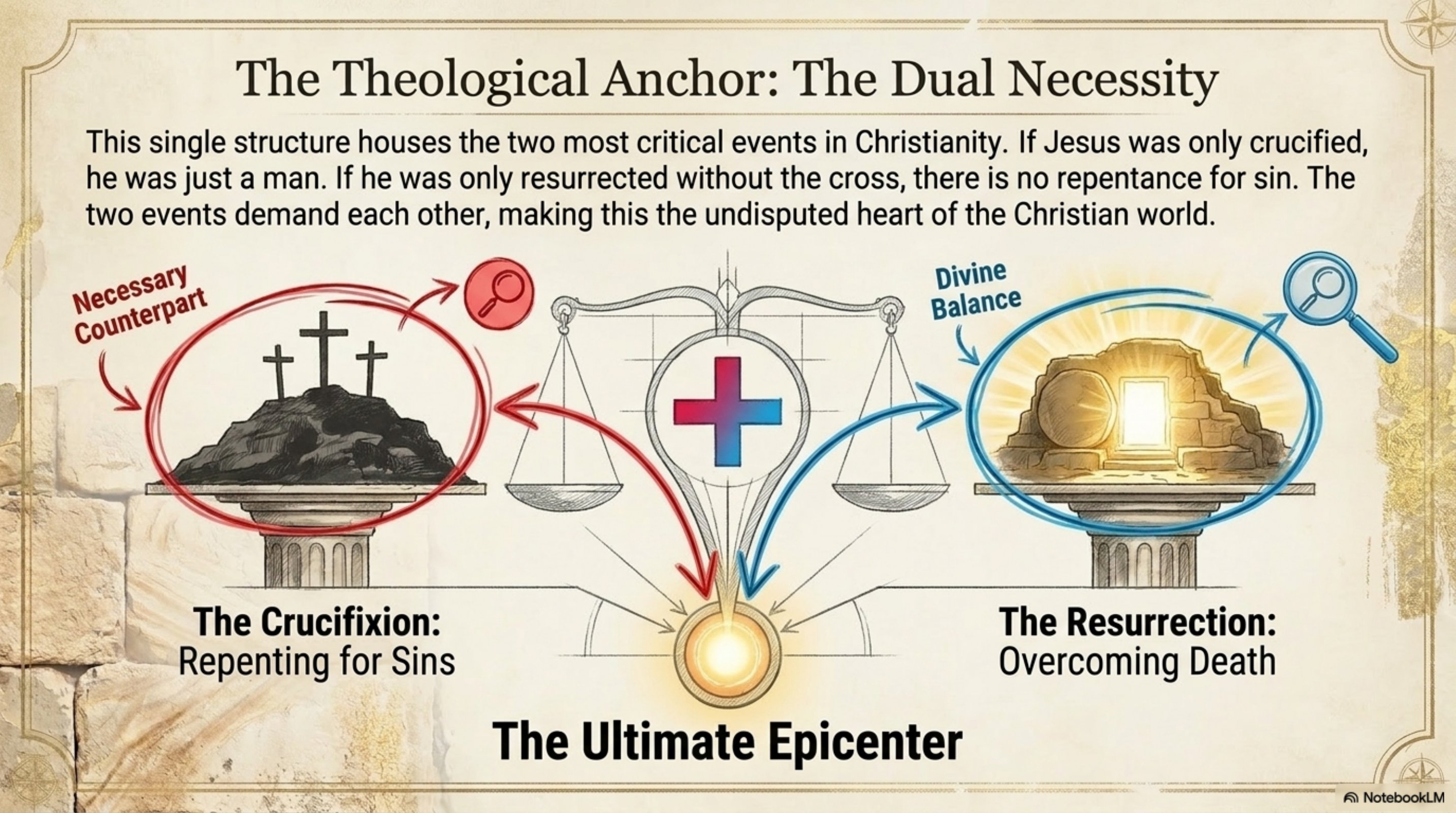
The Theological Anchor: The Dual Necessity
This single structure houses the two most critical events in Christianity. The Crucifixion and the Resurrection are not merely adjacent — they are theologically inseparable. If Jesus was only crucified, he was just a man. If he was only resurrected without the cross, there is no repentance for sin.
"The two events demand each other, making this the undisputed heart of the Christian world."
Golgotha / Rock of Calvary
The Aedicule / Empty Tomb
The Emptiness Paradox
Pilgrims wait up to three hours in a densely packed line for four seconds inside the tomb. What do they see? Nothing. A slab of marble covering bedrock.
"That is the point: the total emptiness of the tomb is the ultimate proof and full realization of the resurrection."
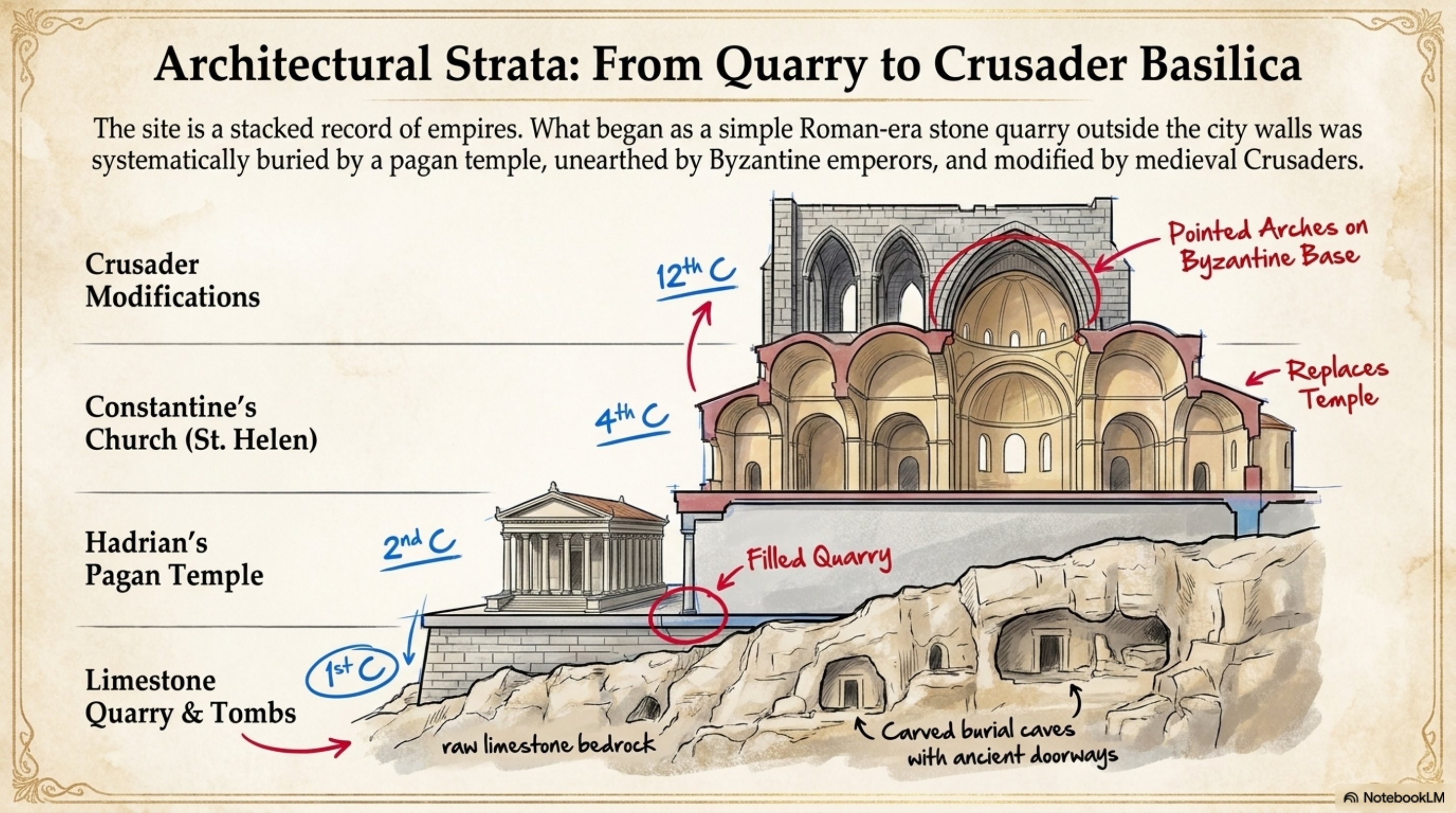
Architectural Strata: From Quarry to Crusader Basilica
The site is a stacked record of empires. What began as a simple Roman-era stone quarry outside the city walls was systematically buried by a pagan temple, unearthed by Byzantine emperors, and modified by medieval Crusaders.
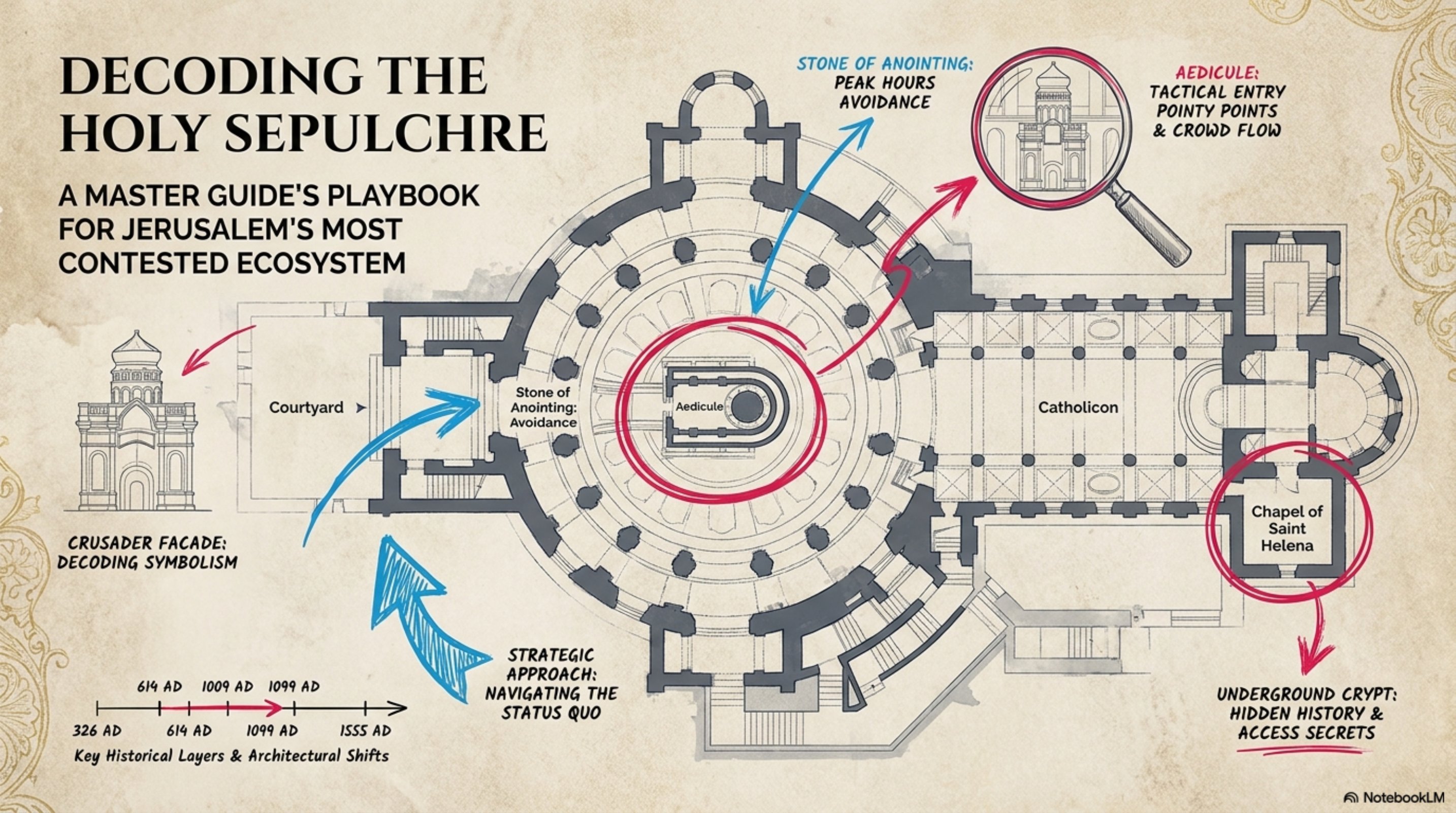
Decoding the Floor Plan
The church's floor plan is a tactical document. Every zone carries a different custodian, a different aesthetic, and a different set of rules. Understanding the layout is the first step to guiding it effectively.
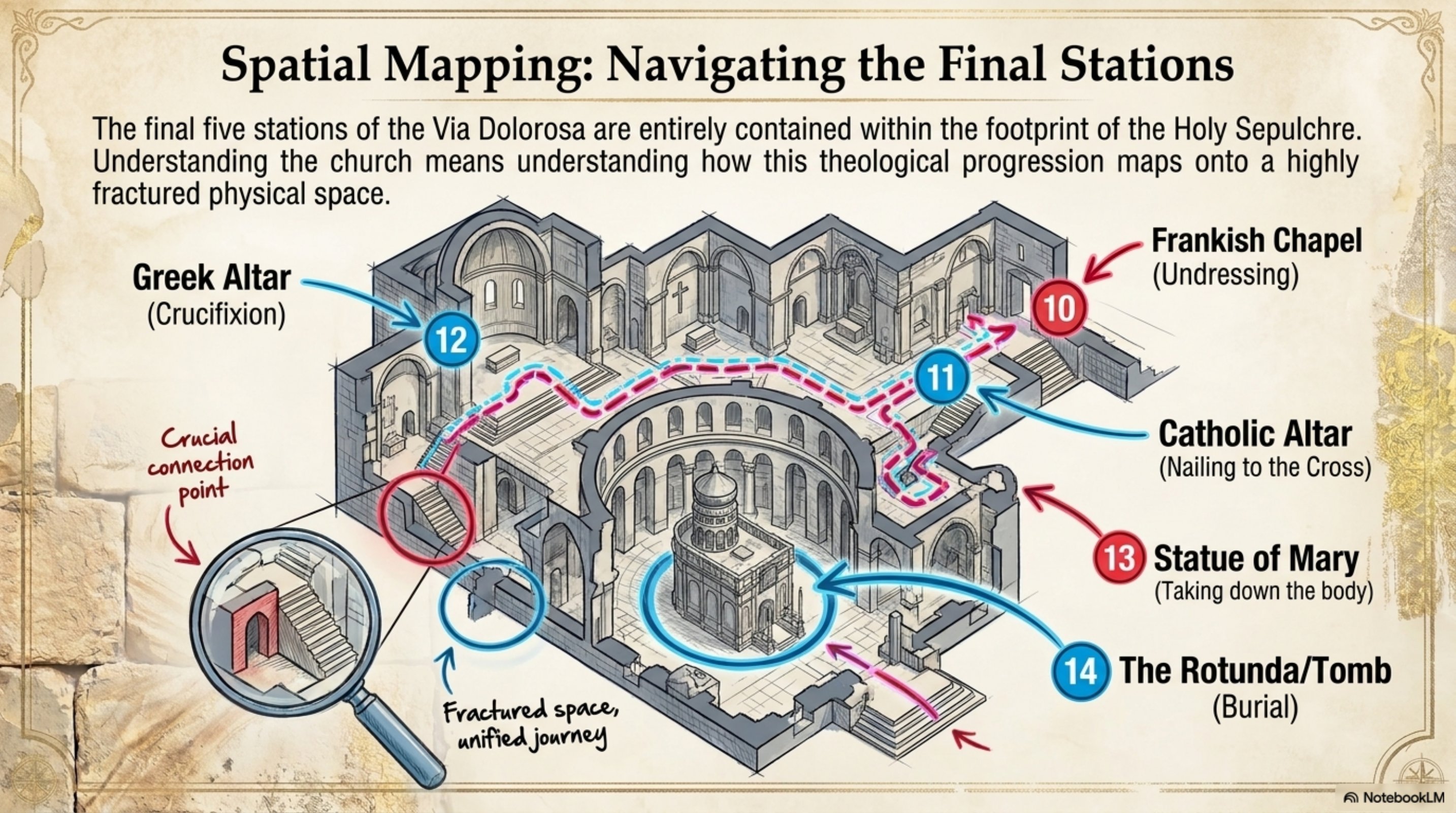
Spatial Mapping: The Final Stations of the Via Dolorosa
The final five stations of the Via Dolorosa are entirely contained within the footprint of the Holy Sepulchre. Understanding the church means understanding how this theological progression maps onto a highly fractured physical space.
The Status Quo: The Unyielding Ecosystem
The church is not run by tradition; it is governed by the "Status Quo" — a rigid, historical power-sharing agreement codified under Ottoman rule (1757, confirmed 1852) that dictates every square inch of the building. It prioritises absolute geopolitical equilibrium over logic, aesthetics, or structural common sense. Nothing moves without everything moving.
The Immovable Ladder
A wooden ladder has stood on the exterior facade since the 18th century. It was placed by a Franciscan monk who had the right to place a lamp there from Ash Wednesday to Pentecost. The lamp is gone; the right — and the ladder — remain. Moving it would require unanimous consent from all six denominations.
The Syriac Chapel
Disputed between Armenians and Syriacs, this chapel has peeling paint and crumbling plaster. Because ownership is contested, no denomination is permitted to renovate it. The Status Quo mandates that preservation of rights supersedes basic maintenance.
Muslim Door Keepers
Since Saladin's conquest in 1187, the key to the church has been held by the Muslim Joudeh family, and the door is opened each morning by the Muslim Nuseibeh family. This arrangement prevents any single Christian denomination from controlling access.
Morning Liturgy Minefield
6:30 AM: Catholic organ begins (deliberately loud enough to drown out others). 7:00 AM: Greek Orthodox chanting. 9:00 AM: Syriac setup. A guide arriving with a group must navigate all three simultaneously.
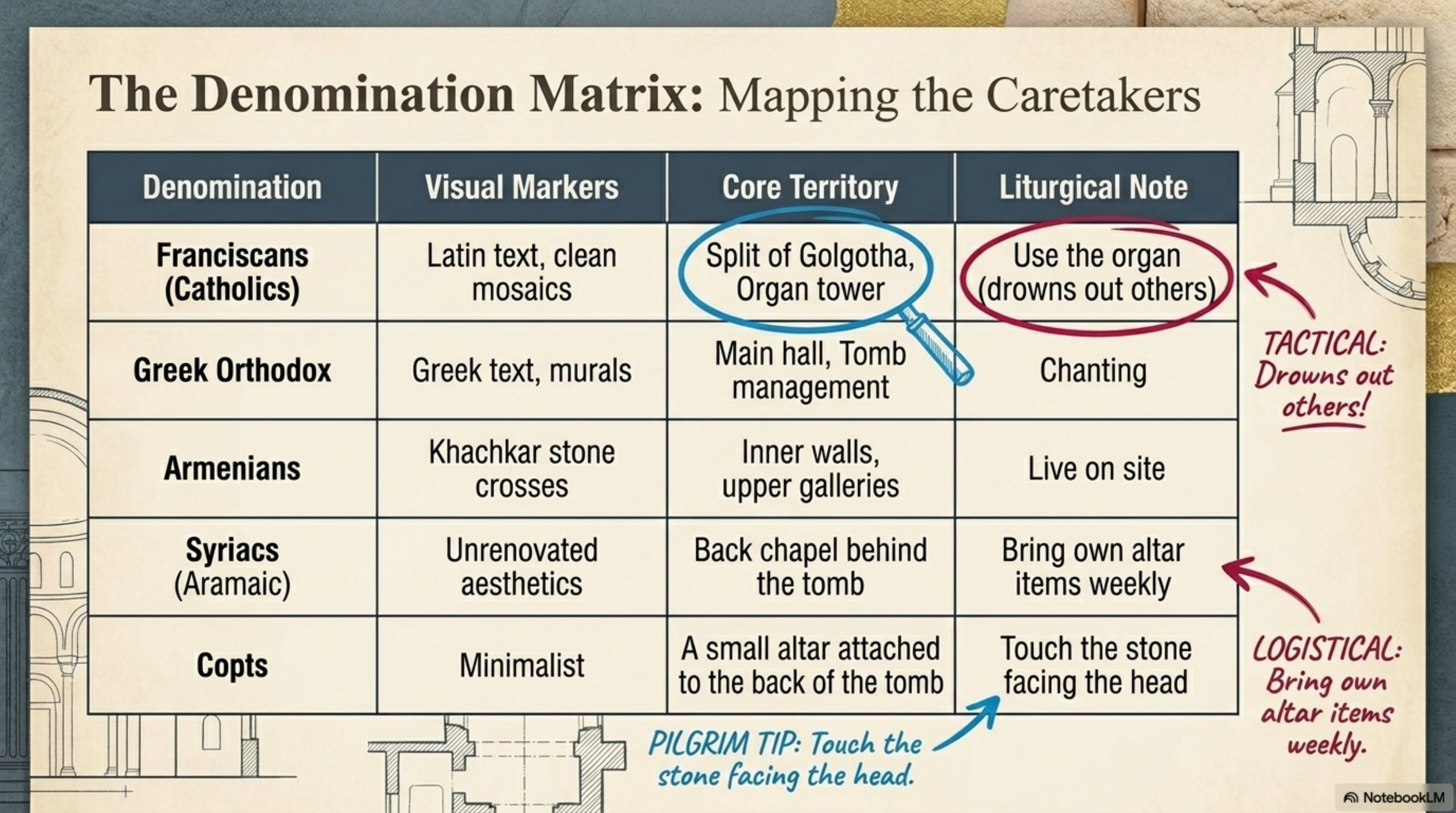
The Denomination Matrix
Six Christian denominations share custodianship of the church, each with distinct visual markers, territorial claims, and liturgical practices. A guide must be able to identify each denomination's zone on sight.
Greek Orthodox
Franciscans (Catholics)
Armenians
Syriacs (Aramaic)
Copts
Ethiopians
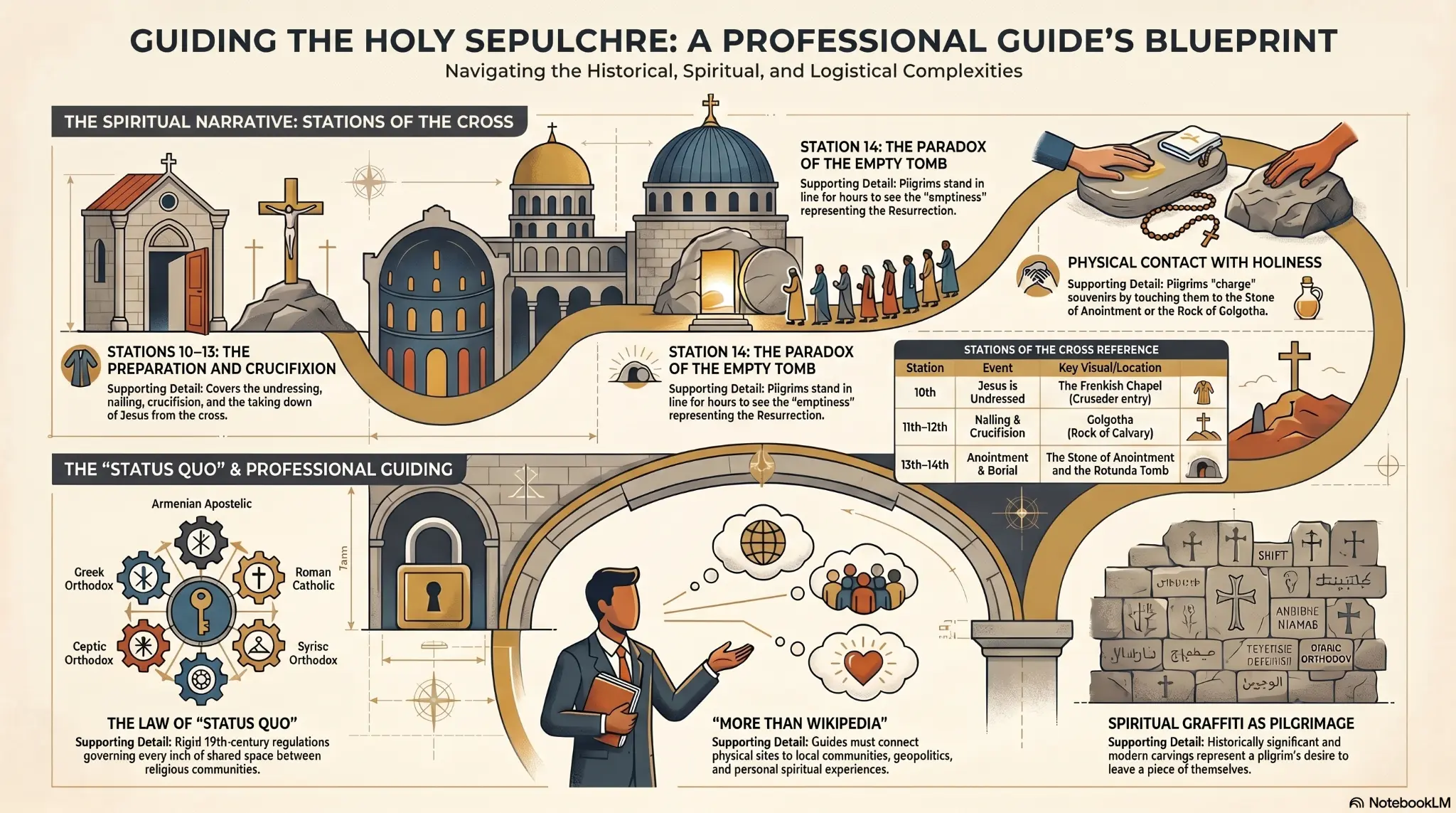
Guiding Blueprint: Professional Guide's Overview
This infographic synthesises the key guiding challenges: navigating the Stations of the Cross, the Status Quo's impact on professional guiding, and the psychological dimensions of pilgrimage — from physical contact with holiness to spiritual graffiti.
The Guide's Mandate: Operating Beyond Wikipedia
Tourists have encyclopedias in their pockets. A guide's value is not reciting dates of destruction and reconstruction. The objective is to synthesise raw history with geopolitical realities, local community dynamics, and the psychological behaviours of pilgrims.
"If you just stand there and recite the history of the building, you fail."
Observe body language at the entry point. Adapt your narrative accordingly — a pilgrim group needs different framing than secular tourists.
The cistern beneath the Chapel of St. Helena has remarkable acoustics. Use the sensory environment to amplify the story.
Link mosaic patterns to Byzantine power structures. Connect street signs to political history. Make the physical space speak.