The Annotated Stratigraphy
Part 3: A master guide's playbook to the Via Dolorosa and the hidden layers of Jerusalem — five strata that every guide must learn to read simultaneously.
Part 3 of a series on the Church of the Holy Sepulchre. This page covers the Via Dolorosa as a concept (not a GPS coordinate), the 5-layer stratigraphy framework, the Antonia Fortress illusion, the Bethesda Pools, the denominational playbook, and the master guide's ultimate insight.
Watch: The Annotated Stratigraphy
Via Dolorosa: The Path of Narrative and Faith
This infographic synthesises the pilgrim's spiritual journey, the tradition vs. archaeology tension, the three historical route phases, and the guide's navigational challenge across 22 Christian denominations.
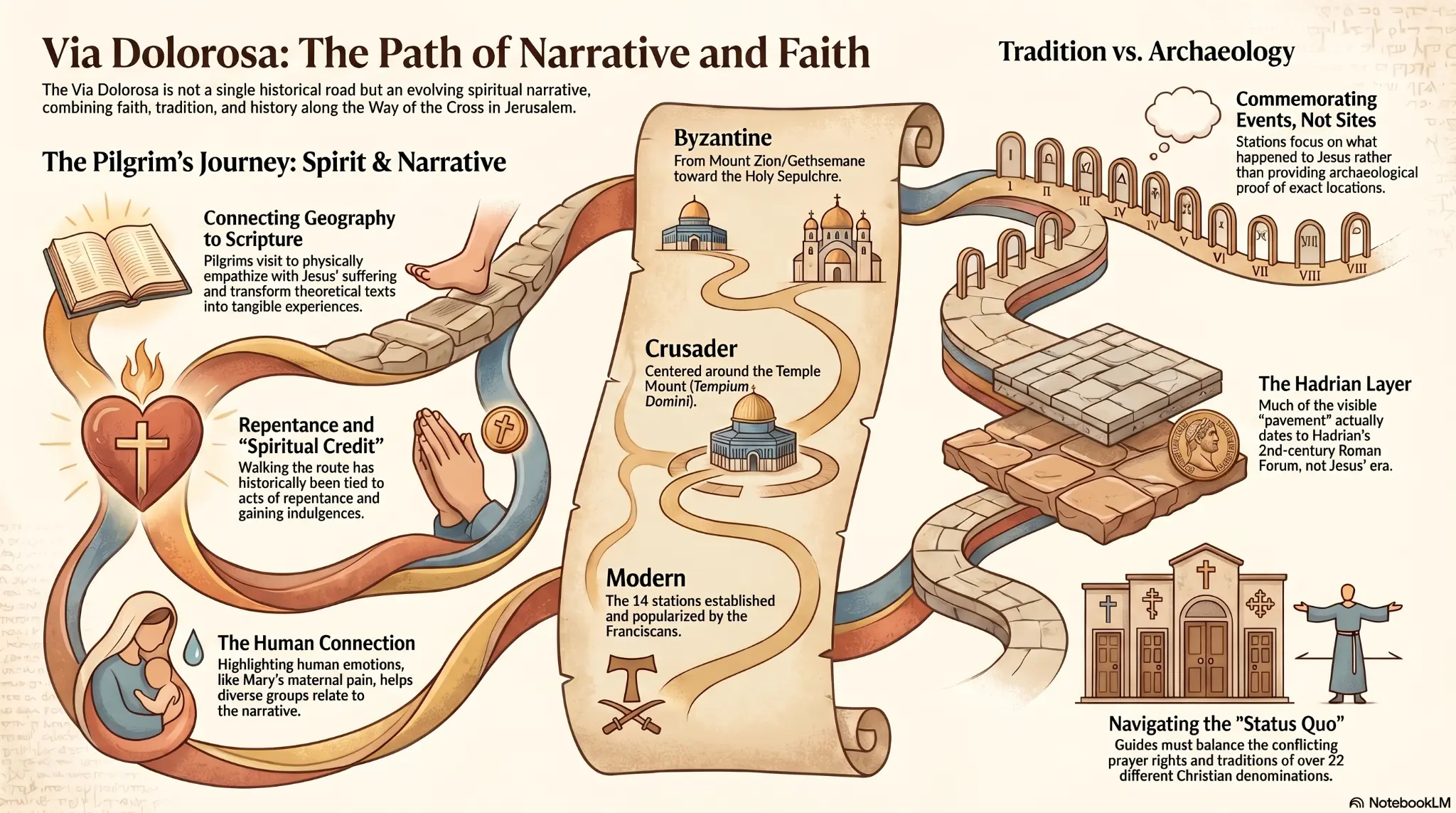
Infographic: NotebookLM
To Understand the City, You Must Read Its Layers.
Jerusalem is not a single city — it is five cities stacked on top of each other, each one built on the ruins of the last. Every stone you stand on is simultaneously a spiritual symbol, a historical artefact, an archaeological puzzle, a political statement, and a practical challenge.
A master guide does not choose between these layers. They read all five at once — and they know which layer to surface for which group, at which moment, on which stone.
The Five Stratigraphic Layers
Every site on the Via Dolorosa can be read through five distinct lenses. The guide who masters all five can serve any group — Catholic, Orthodox, Protestant, secular, or academic — with equal confidence.
Indulgences (like the 2025 Jubilee), repentance, and connecting physical geography to biblical texts. Making the holy book tangible.
This is the primary motivator for the overwhelming majority of visitors. The Catholic Church designates Jerusalem visits — especially during Jubilee years — as an act that gains positive spiritual credit. Pilgrims come to turn abstract theology into concrete understanding. You cannot truly grasp the text until you see the desert and walk the hills. The 2025 Jubilee makes this layer especially relevant: hundreds of thousands of pilgrims will arrive expecting the physical world to confirm what they have read.
The Via Dolorosa is a Concept, Not a GPS Coordinate
The Origin: Cordova
A Spanish Franciscan visits Jerusalem and realises his grandmother cannot make the trip. He invents a framework to bring the Holy Land to her — establishing "Stations" that mark events (not locations) that happened to Jesus.
The Export: European Churches
The Stations become a wildly popular spiritual exercise exported across European churches and hillsides on Good Friday. The spiritual map transcends the physical map. Every church in Europe gets its own Via Dolorosa.
The Import: Back to Jerusalem
Pilgrims arriving in Jerusalem expect to see the specific locations they practiced back home. Franciscans purchase properties and 'pin' these exported stations to physical stones in the city to meet pilgrim expectations.
The Starting Point Moved as Empires Fell
The modern starting point of the Via Dolorosa at the Omaria School is not a 1st-century location — it is a 14th-century political compromise. The route migrated northward as each empire pushed Christians further from the city centre.
Pilgrims walked from Mount Zion to Caiaphas' house, placing the trial at the Hagia Sophia church near the Jewish/Armenian quarters — possibly recalling Herod's Palace.
The Temple Mount becomes 'Templum Domini' and Solomon's Temple. Christian life centers around the Mount and St. Stephen's Gate in the north.
Mamluks reclaim the center. Christians are pushed north. By necessity, the starting point migrates to the Antonia Fortress area — today's Omaria School / Muslim Waqf property — establishing the modern starting line.
The Antonia Fortress Illusion
The most significant archaeological challenge on the entire route
Franciscans built the Condemnation and Flagellation churches (Station 2) and the Sisters of Zion (Ecce Homo) believing the 'Lithostrotos' pavement was where Pilate judged Jesus.
Charles Warren's 19th-century shaft revealed the Strouthion Pool beneath this pavement. Josephus confirms this pool was an open moat during the 1st century — meaning the pavement above it could not have existed in Jesus' time.
The pavement is part of Hadrian's 2nd-century Forum. The 'Ecce Homo' arch is one of Hadrian's triumph arches. The true Antonia Fortress was much smaller and located across the street.
The 14 Stations: Guide's Reference
Each station annotated with its Gospel basis (or lack thereof) and the key guiding insight for that location.
The Ultimate Stratigraphy: The Bethesda Pools
No single site in Jerusalem demonstrates the five-layer stratigraphy more clearly than the Bethesda Pools — five distinct civilisations, each building directly on top of the last, all visible simultaneously in a single excavation.
Given to the French Republic after the Crimean War (1853–1856). Excavated and run today by the 'White Fathers' (Missionaries of Africa). The French flag flies over this site as a direct result of the same geopolitical tensions that produced the 1852 Status Quo.
Saladin transforms the Crusader church into a Madrasa, ironically saving the perfect Crusader architecture from destruction. The best-preserved Crusader church in Jerusalem was preserved by a Muslim ruler.
Crusaders build a small church on the dam, plus the massive St. Anne's Convent for women (visited by Queen Melisande's sister). The convent survives today as one of the finest examples of Crusader architecture in the Holy Land.
Byzantine Church built on massive arches suspended directly over the Roman dam and pools. The engineering required to build a church over two deep pools — without filling them — is extraordinary.
Roman healing site and deep dual pools. The biblical 'five porticoes' remain archaeologically elusive, requiring guide mediation. The pools were a pagan healing site — which is precisely why Jesus chose to perform a healing miracle there.
The Denominational Playbook
The single most important practical skill on the Via Dolorosa. Know your group before you start — the route, the vocabulary, and the endpoint are all different.
⚠️ Crucial for passing the exam
Full 14 stations. Processions occur weekly on Fridays, led by Franciscans, continuing inside the Holy Sepulchre.
Execute full Via Dolorosa to the Holy Sepulchre.
Walk the path, but refer to it as the 'Way of the Cross' — avoid Latin terminology. Often stop at all stations by popularity, but officially recognize only NT-referenced stations.
Stop ONLY at Gospel-referenced stations (1, 2, 5, 8).
Many use the Via Dolorosa as a spiritual exercise. Most respect the Holy Sepulchre's history, but prefer the Garden Tomb (identified in the 1880s) for prayer and authentic aesthetic.
NEVER take to the Holy Sepulchre. Route directly to the Garden Tomb.
The Ultimate Insight: Read the Room.
The Geographic Reality
You will stand on 2nd-century paving stones from Hadrian's Forum with pilgrims who are weeping because they believe it is the blood-stained floor of the Antonia Fortress.
The Spiritual Reality
A sequence of exported spiritual concepts, not GPS coordinates. The stones are merely tools for emotional transformation. The pilgrim's experience is real, regardless of the archaeology.
"A master guide does not use archaeology to destroy faith. If the group is seeking a profound emotional connection, do not interrupt their prayer with Charles Warren's archaeological shafts. If they ask for the history, provide the stratigraphy. The transformation of the pilgrim is the destination."
Series: Church of the Holy Sepulchre