Tel Lachish
The Shield of Judah and the Crossroads of Empires
The Dossier · 13 Field Reports
Field Report No. 01 of 13
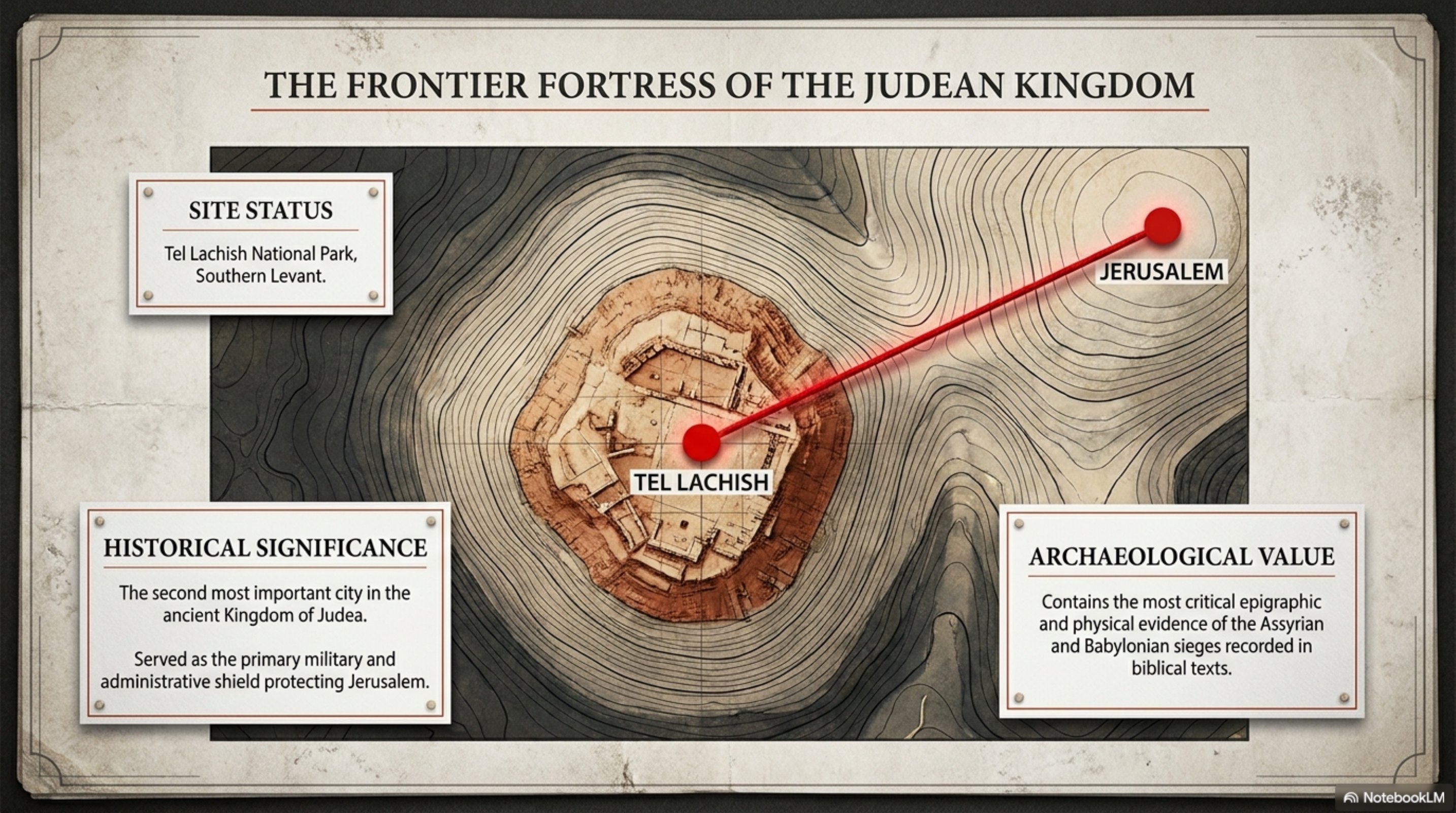
The Frontier Fortress of the Judean Kingdom
Field Video
Tel Lachish — When the Dirt Proves the Text
The Guide's Narrative
Standing at the base of Tel Lachish, you immediately understand why the ancient Judeans chose this spot. The tel rises dramatically from the Shephelah plain — not the tallest hill in the region, but perfectly positioned at the crossroads of the coastal road and the route up to Jerusalem. It is a natural sentinel, and the Judeans made it into something more: the second most important city in the kingdom, a statement of royal power visible for miles.
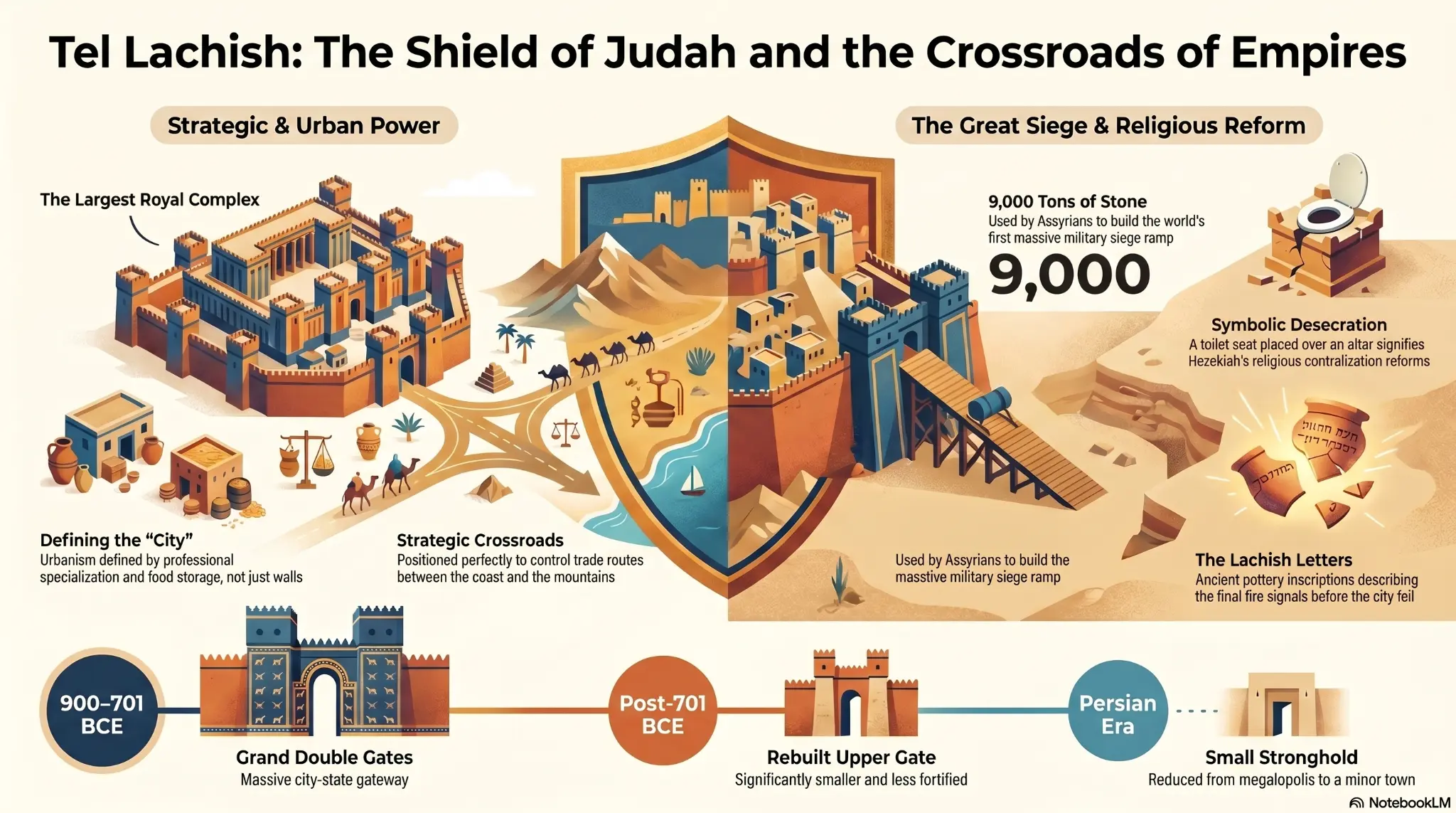
What strikes me every time I visit is the scale of what happened here. The Assyrian siege ramp — still partially visible today — represents an almost incomprehensible engineering achievement. Six to nine thousand tons of fieldstone, hauled and stacked under the personal gaze of King Sennacherib, who was so proud of this victory that he had it immortalized in massive stone reliefs at his palace in Nineveh. Those reliefs are now in the British Museum, and they are extraordinary: you can see the battering ram, the defenders throwing torches, the prisoners being led away. Lachish was Sennacherib's greatest military achievement, and he wanted the world to know it.
The city gate complex is one of the best-preserved six-chambered gates in Israel. Walking through it, you can feel the weight of the history — this is where commerce happened, where legal disputes were settled, where the city's social life played out. And it is also where, in 586 BCE, the Babylonian army finally broke through after a brutal siege.
The Lachish Letters, found in the gate guardroom in 1935, are among the most moving artifacts in all of Israeli archaeology. Written in ink on clay potsherds by a military commander named Hoshaiah to his superior at Lachish, they capture the desperate final days of the Babylonian assault. Letter No. 4 contains the haunting line: "May my lord be apprised that we are watching for the fire signals of Lachish... because we cannot see Azekah." Azekah had already fallen. Lachish was next. And then Jerusalem.
For tour guides, Lachish is a gift. It has everything: military history, archaeology, epigraphy, religious reform, and a direct connection to the biblical narrative. The story of Hezekiah's religious centralization — symbolized by the toilet seat placed over the altar in the local shrine — is the kind of detail that makes visitors laugh and then think deeply about what it meant to be a Judean in the 8th century BCE.
Exam Fast Facts
Location
Shephelah foothills, 40 km SW of Jerusalem
First Siege
701 BCE — Assyrian King Sennacherib
Second Siege
586 BCE — Babylonian King Nebuchadnezzar
Judean King (701)
King Hezekiah
Judean King (586)
King Zedekiah
Siege Ramp
6,000–9,000 tons of fieldstone; only surviving ancient siege ramp
The Lachish Letters
18 ostraca (clay potsherds) found in 1935 by James Starkey
Key Quote
"We cannot see the fire signals of Azekah" — Lachish Letter No. 4
Hezekiah's Reform
Toilet seat placed over altar at Lachish shrine — symbolic desecration
Excavator
James Starkey (1930s British); David Ussishkin (1970s–80s Tel Aviv Univ.)
Published March 15, 2025
More Site Profiles