The Dead Sea Scrolls
Unlocking the Secrets of Ancient Faith
The Guide's Narrative
The story of the Dead Sea Scrolls begins with a goat and a thrown stone. In 1947, a Bedouin shepherd boy named Muhammad edh-Dhib was searching for a lost goat near the cliffs above the Dead Sea when he threw a stone into a cave and heard the sound of pottery shattering. Inside, he found large clay jars containing ancient leather scrolls wrapped in linen. He had no idea what he had found. Neither did anyone else, at first.
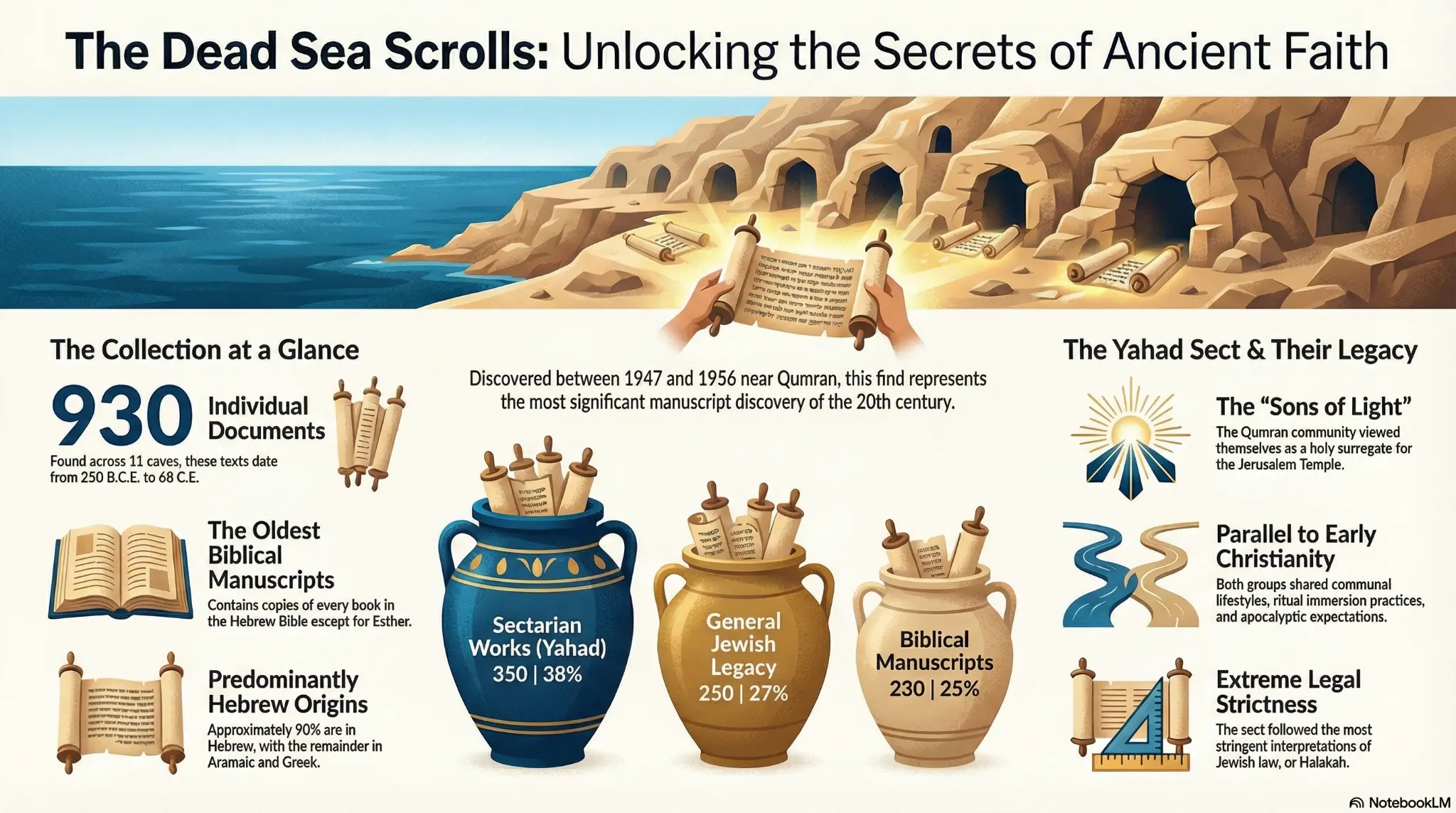
What followed was one of the most significant — and sometimes contentious — archaeological discoveries of the 20th century. Over the next decade, eleven caves near Qumran yielded 930 documents dating from 250 BCE to 68 CE. Among them were copies of every book of the Hebrew Bible except Esther, pushing back our oldest manuscript evidence by nearly a thousand years. When scholars compared these ancient texts to the medieval manuscripts that had previously been our oldest copies, they found them remarkably consistent — a testament to the extraordinary care with which Jewish scribes transmitted the biblical text across the centuries.
But the scrolls are more than just biblical manuscripts. The majority — 38% — are sectarian texts belonging to a group scholars call the Yahad, almost certainly the Essenes described by Josephus and other ancient writers. These texts reveal a community that had withdrawn from Jerusalem society in protest against what they saw as a corrupt priesthood. They called themselves the "Sons of Light" and believed they were living in the final days before a great cosmic battle between good and evil.
The parallels with early Christianity are striking and have generated enormous scholarly debate. Both communities practiced ritual immersion, shared communal meals, held property in common, and expected an imminent apocalyptic transformation of the world. The scrolls do not mention Jesus or early Christianity, but they illuminate the Jewish world from which Christianity emerged — a world of intense messianic expectation, apocalyptic fervor, and radical sectarian diversity.
Exam Fast Facts
Discovery
1947–1956 near Qumran, by Bedouin shepherds
Total Documents
930 individual documents across 11 caves
Date Range
250 BCE to 68 CE
Languages
~90% Hebrew; remainder Aramaic and Greek
Sectarian Works
350 documents (38%) — Yahad/Essene community texts
Biblical Manuscripts
230 documents (25%) — every Hebrew Bible book except Esther
The Yahad Sect
Viewed themselves as 'Sons of Light'; holy surrogate for Jerusalem Temple
Key Parallel
Shared communal lifestyle, ritual immersion, and apocalyptic expectations with early Christianity
Significance
Oldest known biblical manuscripts; pushed back textual evidence by 1,000 years
Published April 1, 2025
_040eb681.webp)