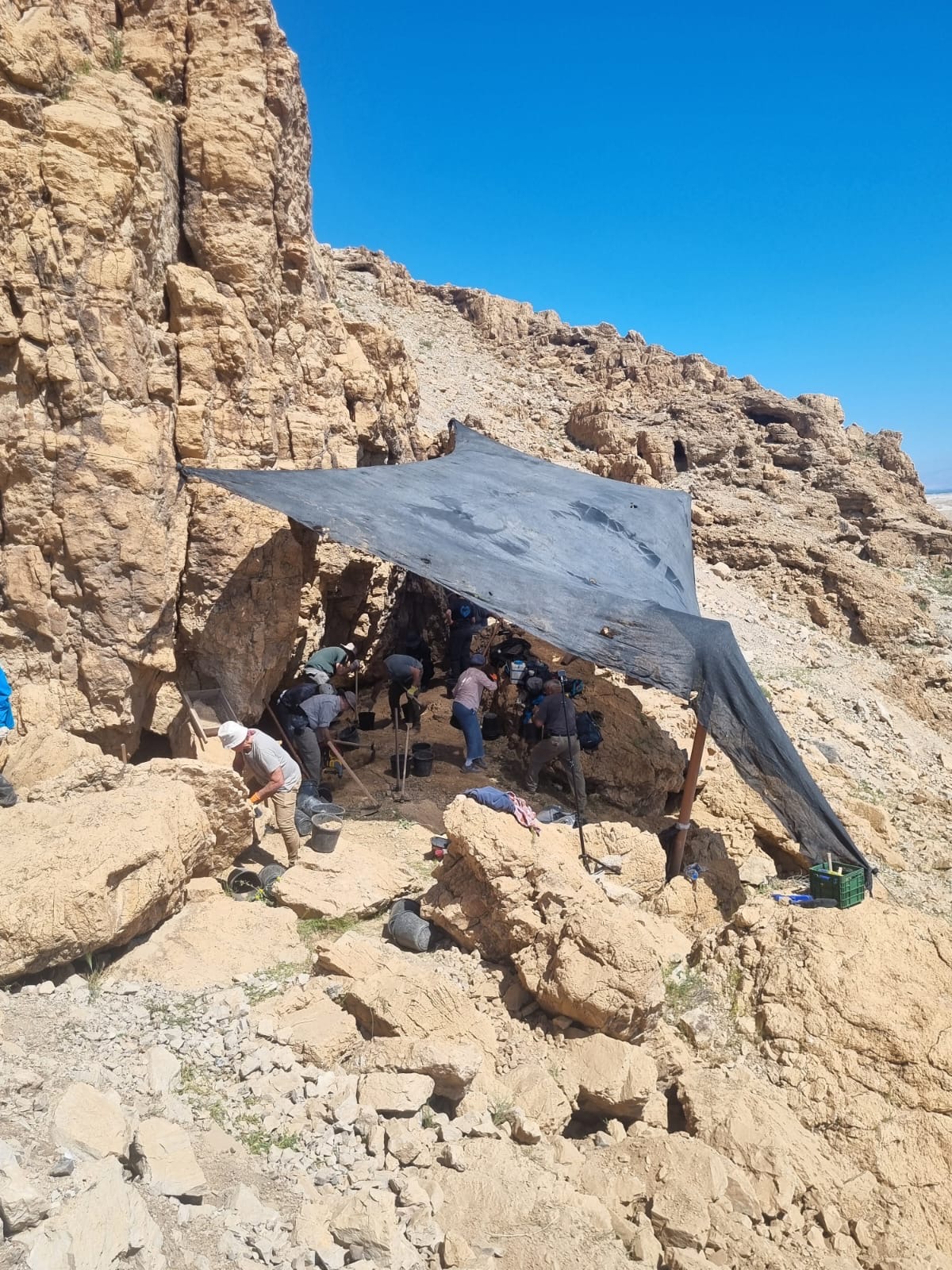
The Burma Road
The 1948 Battle to Secure Supplies to Jerusalem
The Dossier · 15 Field Reports
Field Report No. 01 of 15
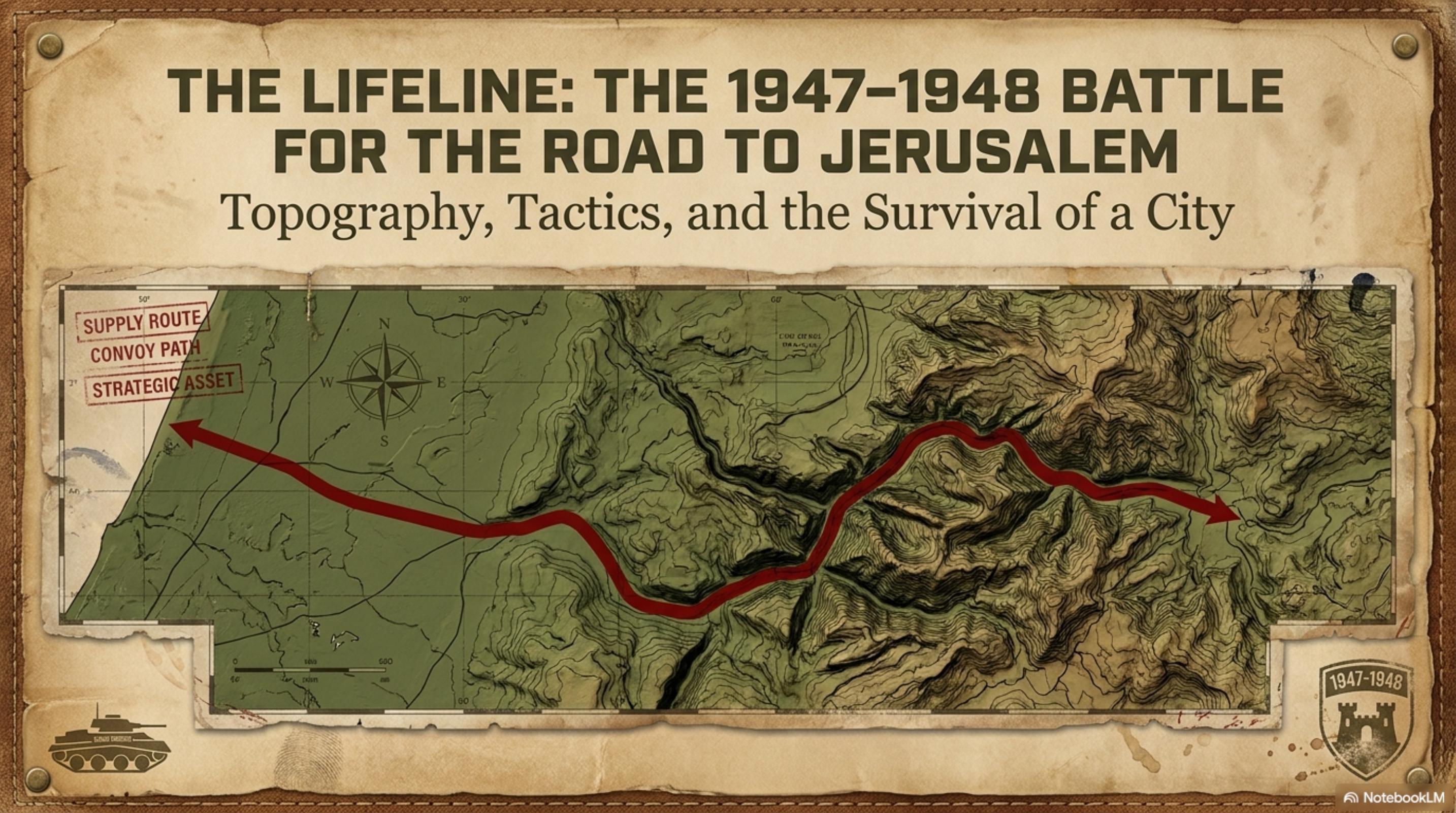
The Lifeline: Topography, Tactics, and the Survival of a City
Field Video
The Burma Road — When the Dirt Proves the Text
The Guide's Narrative
The road from Tel Aviv to Jerusalem is today a smooth, well-lit highway that you can drive in under an hour. But in the spring of 1948, that same road was the most dangerous stretch of ground in the world — a single-lane track through the Judean hills where Arab fighters held every hilltop and Jewish convoys were ambushed, burned, and destroyed with terrifying regularity. The rusting hulks of those armored trucks still line the roadside today, painted in memorial orange, and every Israeli driver passes them without really thinking about what they represent.
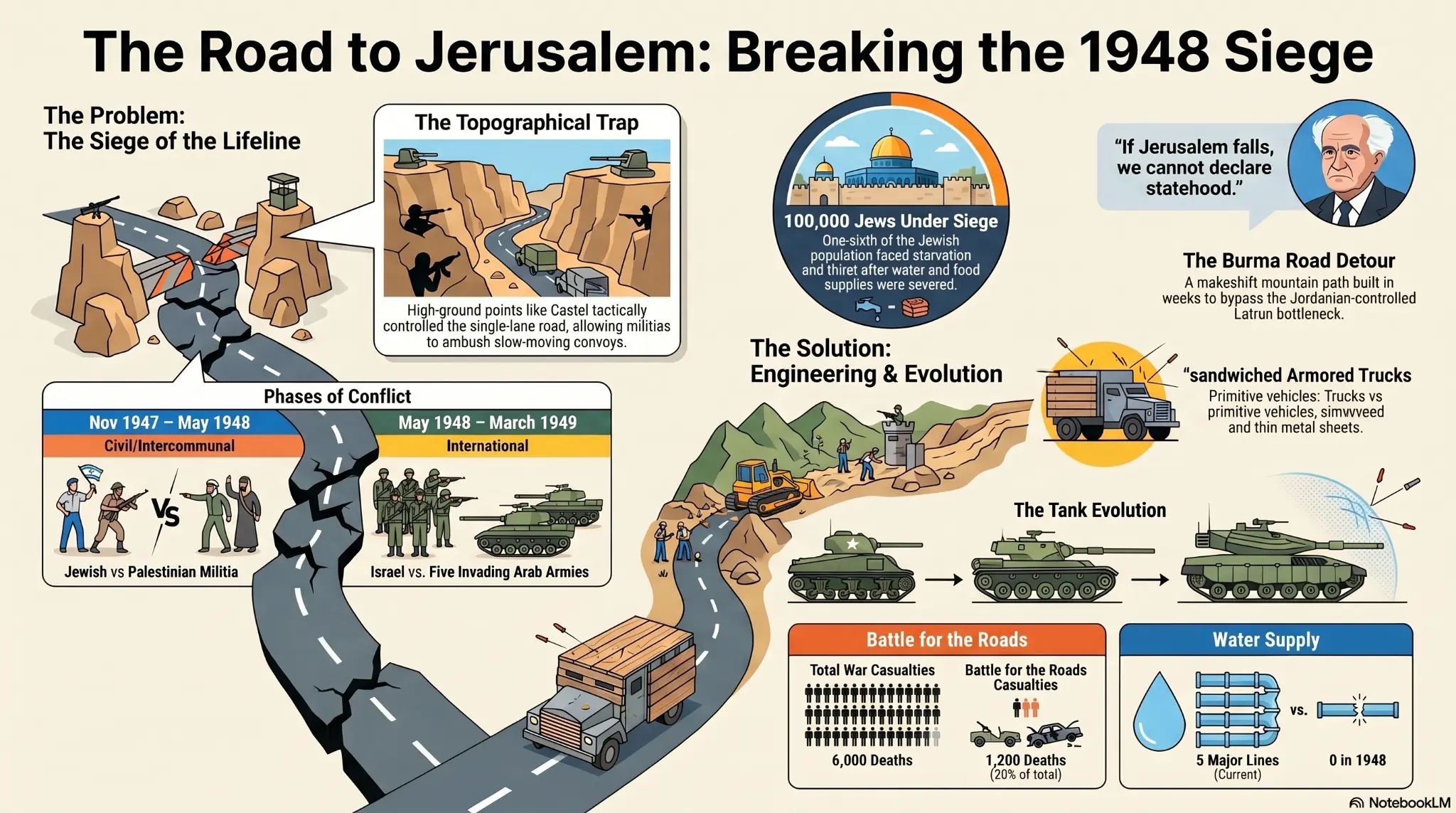
What they represent is nothing less than the survival of the Jewish state. Ben-Gurion said it plainly: "If Jerusalem falls, we cannot declare statehood." One hundred thousand Jews — one-sixth of the entire Jewish population of Mandatory Palestine — were trapped in a city with no food, no water, and no way out. The Arab strategy was not to storm Jerusalem but simply to starve it into surrender before May 14, 1948, the date of the British withdrawal and the planned declaration of independence.
The topography made this strategy devastatingly effective. The road climbs through a series of narrow defiles where the hills press in from both sides. A single machine gun position on the high ground at Castel could stop an entire convoy. The Haganah tried to run armored trucks — improvised vehicles with scrap metal bolted to commercial chassis, nicknamed "sandwiches" — but they were slow, mechanically unreliable, and easy targets. The road became a graveyard.
Operation Nachshon in April 1948 temporarily broke the siege, but the fall of Castel and the Deir Yassin massacre in the same week created a psychological earthquake that transformed the entire conflict. The Arab propaganda about Deir Yassin backfired catastrophically, triggering the mass flight of the Palestinian middle class and accelerating the collapse of Arab civil society. The Hadassah Convoy massacre four days later — 78 Jewish doctors, nurses, and students burned alive on their way to Mount Scopus — showed that neither side was fighting a clean war.
The Burma Road is the story that every guide should know cold. When the Latrun fortress proved impregnable — three bloody assaults failed, including one by Holocaust survivors who had literally just stepped off the boat — Israeli engineers found a goat path through the hills that bypassed the entire Jordanian position. They widened it by hand, at night, in secret, in two weeks. The first convoy crept through on June 10, 1948. Jerusalem was saved. And the DNA of improvisation, of refusing to accept impossible terrain as a final answer, that was born on that road — it is the same DNA that built the Merkava tank.
Exam Fast Facts
Key Date
November 29, 1947 — UN Resolution 181 (Partition Plan) passed
Jerusalem Population (1948)
100,000 Jews (1/6 of total Jewish population) under siege
Phase 1
Nov 1947 – May 1948: Civil/Intercommunal War — Jewish vs. Palestinian Militia
Phase 2
May 1948 – March 1949: International War — Israel vs. Five Arab Armies
The Topographical Trap
Single-lane road through Judean hills; high ground at Castel controlled by Arab forces
Operation Nachshon
First major Haganah offensive (April 1948); broke the siege temporarily
The Latrun Battles
Three failed Israeli assaults on Jordanian-held Latrun fortress; heavy casualties
The Burma Road
Secret bypass road built in weeks through impossible terrain to circumvent Latrun
Total War Casualties
~6,000 deaths; Battle for the Roads = ~1,200 (20% of total)
Legacy
The improvised 'sandwich' armored trucks evolved into the DNA of the Merkava tank
Published April 15, 2025
_040eb681.webp)