Unearthing Beit Guvrin:
Where Eras Collide
Discover the ancient acropolis where a medieval Crusader fortress was built directly on top of a Roman gladiator arena
In the Judean foothills, a single hilltop holds 2,000 years of layered civilization: a Roman amphitheater where Jewish captives were forced to fight, a Byzantine market built on its ruins, a Crusader fortress built on top of that — and beneath it all, a stolen inscription that rewrote the history of Hanukkah.
Site Overview
Beit Guvrin: Layers of Judea
Field Video
Beit Guvrin on Location
Archaeological Stratigraphy
Four Eras, One Hilltop
Select an era to explore what was built, destroyed, and buried on this single acropolis.
1st–2nd Century CE
Roman Foundation
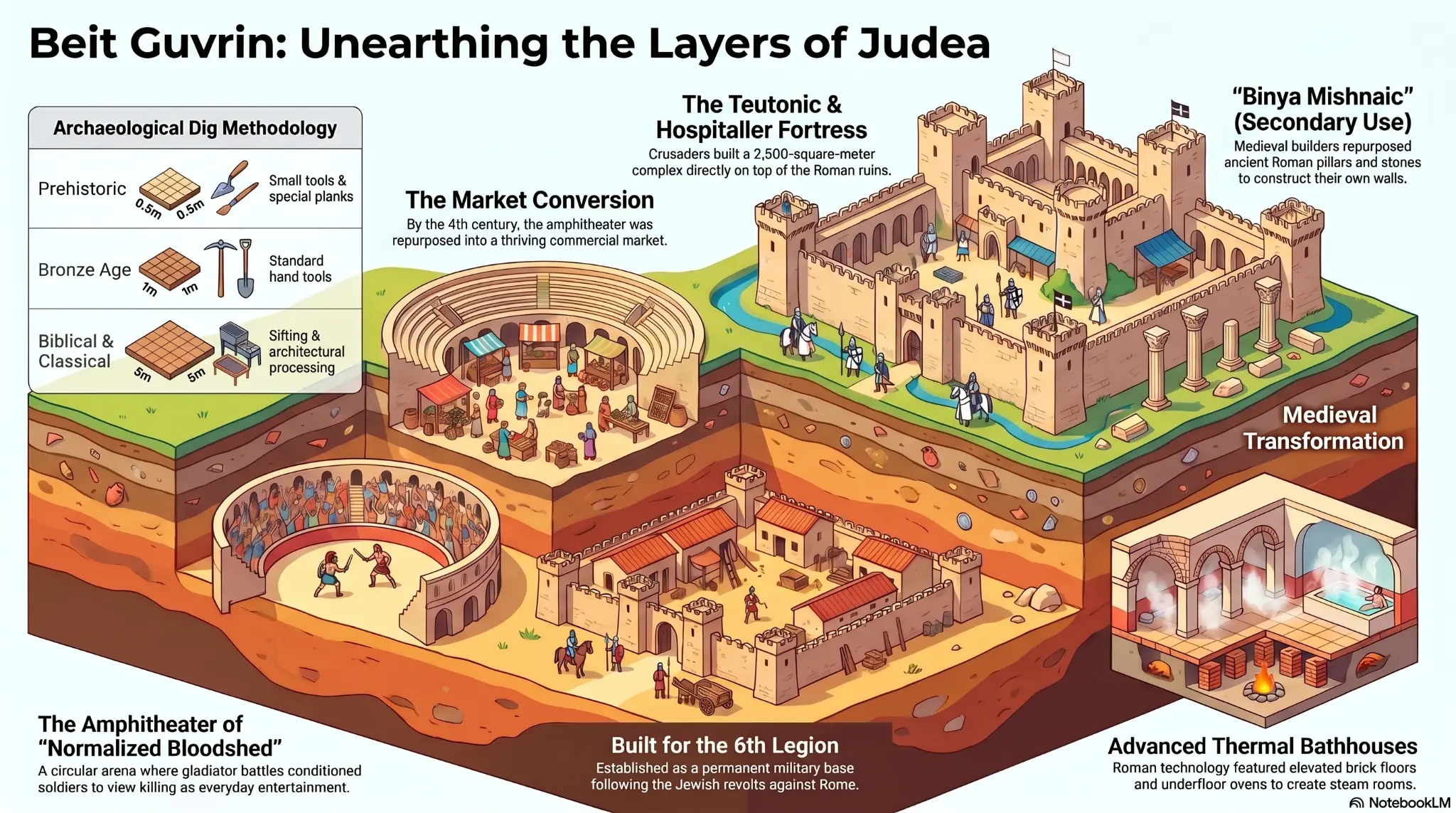
The 6th Roman Legion establishes a permanent military base here after the Jewish revolts. They build a hybrid stadium-hippodrome, later walled off into a full amphitheater — a machine for normalizing bloodshed among soldiers.
- Amphitheater built to entertain the permanently stationed 6th Legion
- Originally a hybrid stadium and hippodrome before becoming a walled arena
- Captured Jewish soldiers from the Bar Kokhba revolt forced to fight here
- Underground aedicula (shrine) found beneath the arena floor — filled with menorah oil lamps
- Jewish captives prayed there without pagan idols before facing death
- Outdoor gymnasium and sophisticated bathhouse with elevated heated floors
Section One
The Roman Amphitheater & The 6th Legion
After the catastrophic Jewish revolts, Rome stationed the 6th Legion permanently in the Judean foothills. To keep their soldiers battle-hardened and psychologically prepared for violence, they built an entertainment complex unlike anything else in the region — first a hybrid stadium and hippodrome, then a fully walled amphitheater designed to normalize bloodshed.
The arena was not merely entertainment. It was a deliberate psychological tool: soldiers who watched killing as daily entertainment became soldiers who killed without hesitation. The Romans understood this with cold precision.
Captured Jewish soldiers from the Bar Kokhba revolt were forced into the arena to fight. Archaeologists made a haunting discovery: beneath the arena floor, a small underground shrine — an aedicula — filled with menorah oil lamps. These Jewish captives prayed there before facing death, in a space deliberately free of pagan idols.
Above ground, the Romans lived well. An outdoor gymnasium and a sophisticated bathhouse with elevated brick floors, underfloor ovens, steam rooms, and hot baths served the garrison. By the Byzantine period, gladiator games were outlawed and the arena became a covered market.
The Guide's Insight
The Underground Shrine: Faith Beneath the Arena
The aedicula beneath the arena floor is one of the most moving discoveries in Israeli archaeology. In a space designed for death, Jewish captives carved out a tiny pocket of dignity — a shrine with no pagan imagery, only the light of menorah lamps. They prayed in the language of their ancestors before being sent to die for Roman entertainment. The oil lamps they left behind are now in the Israel Museum.
Section Two
The Crusader Fortress
Built on Roman Bones
The Teutonic Order constructed a 2,500 m² fortress directly over the Roman ruins. The site then passed through Hospitaller, Saladin, Mamluk, and Mongol hands — each layer of conquest leaving its own marks.
Binya Mishnaic
Medieval builders recycled ancient Roman pillars and column drums as foundation walls — a practice the Mishnah calls 'secondary use.' The same marble that once decorated Roman public spaces became the bones of a Crusader wall.
Masons' Marks
Proud craftsmen carved small personal signatures — 'masons' marks' — into the marble stones as proof of their work so they could be paid. These tiny carved symbols are still visible on the stones today.
Historical Trivia
The Fortress That Smelled Terrible
The Crusaders built their communal dining hall (refectory) directly above the sophisticated Roman sewage system — and completely ignored it. Rather than connecting to the existing drainage infrastructure, they simply let waste accumulate beneath the floor. The fortress, for all its martial grandeur, reportedly smelled appalling. It is a telling reminder that military prowess and basic sanitation are not the same thing.
Section Three
The Black Market Heist & The Hanukkah Stone
Beneath Beit Guvrin lies a favissa — an underground cave archive once used to store discarded cultic objects. In 2004, nighttime robbers broke in and stole massive stones bearing ancient inscriptions.
The stolen artifact became known as the Heliodorus Stele — the largest stone inscription ever found in Israel. It was smuggled out of the country and sold on the black market in New York City before eventually being tracked down and returned to the Israel Museum.
The inscription's historical impact was enormous: it documents a pagan official authorizing tax collection from the Jewish temple — providing the exact historical background for the Maccabean Revolt and the story of Hanukkah. A stone stolen by thieves in the night turned out to be one of the most important epigraphic finds in the history of the Land of Israel.
What is a Favissa?
An underground cave archive for discarded cultic objects — a sacred 'discard pile' for religious items no longer in use.
When was it stolen?
2004 — nighttime robbers broke in and removed massive inscribed stones.
Where was it sold?
On the black market in New York City, before being returned to the Israel Museum.
Why does it matter?
It documents pagan tax collection from the Jewish temple — the precise historical trigger for the Maccabean Revolt and Hanukkah.
Section Four
The Site Today
Beit Guvrin–Maresha National Park is a UNESCO World Heritage Site. Visitors can walk through the exposed Roman amphitheater, the Crusader fortress walls, and the Bell Caves — a network of underground quarry caves unique to this region. Only a small portion of the ancient acropolis has been excavated; the vast majority of the site remains buried, waiting.
Roman Amphitheater
Walk the arena floor where gladiators and Jewish captives once fought for Roman entertainment.
Crusader Fortress
Explore the 2,500 m² fortress walls and spot the recycled Roman columns and masons' marks.
Bell Caves
A network of underground quarry caves — narrow at the top, wide at the bottom — unique to this region.
UNESCO Heritage
Beit Guvrin–Maresha is a UNESCO World Heritage Site. Only a fraction of the acropolis has been excavated.
Field Dossier
Unearthing Beit Guvrin
Full slide dossier — the complete field playbook for this site.
Exam Preparation
Fast Facts: Beit Guvrin
Key dates, names, and concepts the exam tests
Q1
What Roman unit was stationed at Beit Guvrin?
The 6th Legion, permanently stationed after the Jewish revolts.
Q2
What was the original form of the amphitheater?
A hybrid stadium and hippodrome before being walled off into a full arena.
Q3
What was found beneath the arena floor?
An underground aedicula (shrine) filled with menorah oil lamps — used by Jewish captives before fighting.
Q4
What is 'Binya Mishnaic'?
Secondary use — the Crusader practice of recycling ancient Roman pillars and stones as building material.
Q5
What are 'Masons' marks'?
Small carved signatures on marble stones — craftsmen's proof of work so they could be paid.
Q6
Why did the Crusader fortress smell terrible?
They built their refectory directly over the Roman sewage system and completely ignored it.