Bethesda Pools & St. Anne's Church
The Stratigraphy of Faith — five layers of history stacked on the same GPS coordinates, from a Judean water reservoir to a contested modern pilgrimage site.
Sacred Waters and Stone: The Layers of Bethesda and St. Anne
This infographic synthesises the Bethesda Pools as a legacy of healing, the Church of St. Anne as an architectural marvel, and the chronological development of the water system from 8th century BC to the present.
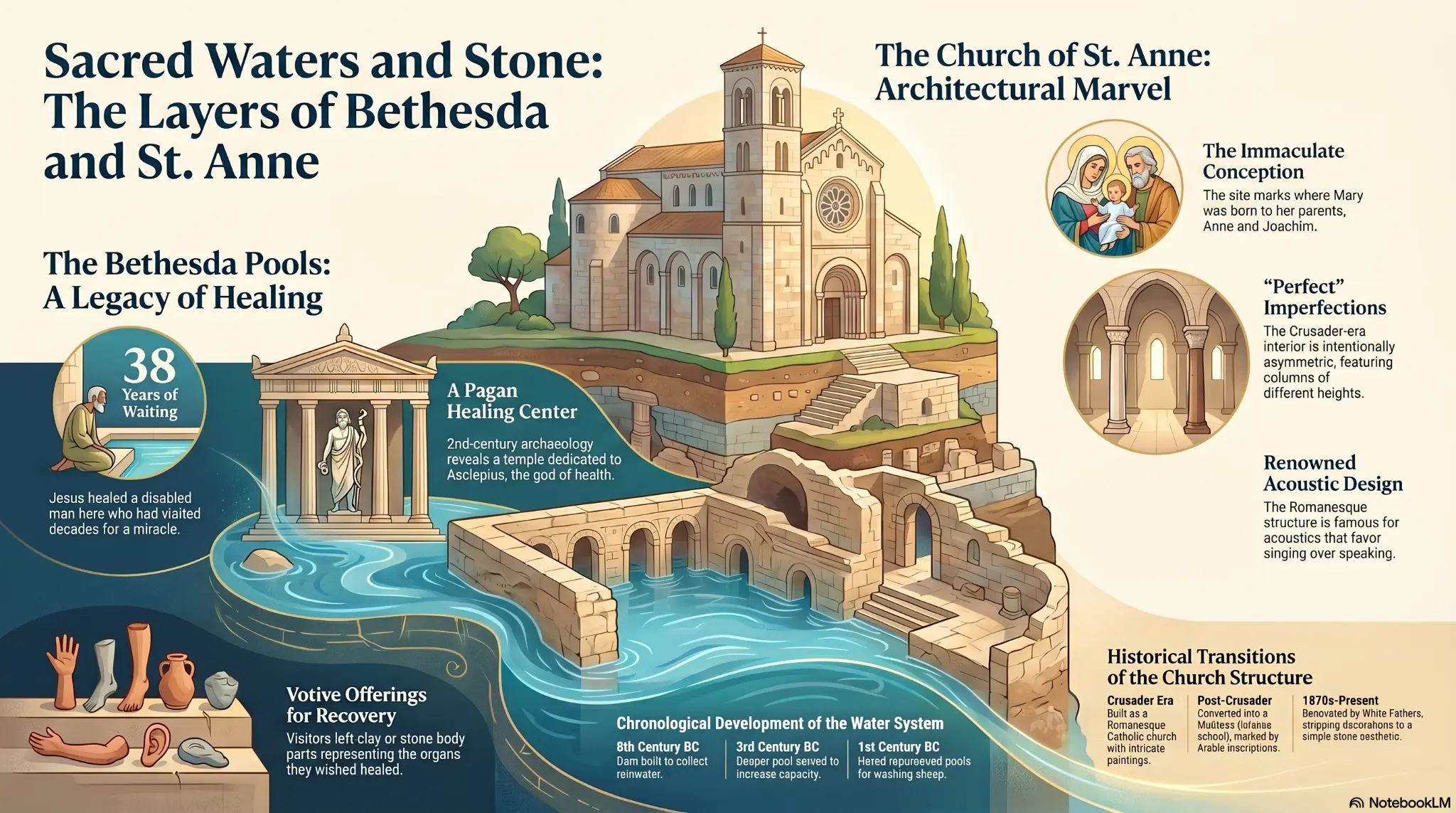
Infographic: NotebookLM
History Here Does Not Move Forward. It Stacks Upward.
The Galip Saiton valley reveals the ultimate truth of Jerusalem's archaeology: across millennia, the exact same GPS coordinates have evolved to serve the vital, shifting needs of whoever held the city. A water reservoir became a pagan healing spa, which became a Christian miracle site, which became an Islamic school, which became a contested pilgrimage destination.
No single site in Jerusalem demonstrates the five-layer stratigraphy more clearly than the Bethesda Pools. Every layer is still visible — and the guide who can read all five simultaneously can serve any group, from secular archaeologist to devout pilgrim.
The Five Stratigraphic Layers
From the bottom of the excavation to the present day — five distinct civilisations, each building directly on top of the last, all visible simultaneously in a single site.
The Galip Saiton valley served a purely functional purpose long before it was a site of pilgrimage. Flanked by two hills, its natural basin made it the perfect location to collect rainwater required for early Temple operations. The Upper Pool (8th C BC) may be Isaiah's 'Upper pool near the field of Kves' (the laundry field). The Lower Pool (3rd C BC) deepened the system. By the 1st Century BC, Herod renovated the Temple's water system, piping water in from the south — leaving massive bodies of water available for new, unintended uses.
Reconciling the Strata: Text vs. Dirt
Mentions the "Sheep Gate", 5 porticoes, moving waters causing healing, and a man waiting 38 years for a miracle. The pool is described as a place where "a great number of disabled people used to lie."
Ruins of a pagan temple dedicated to Asclepius (god of health), dual pools, and a Roman healing center. Stone and clay votive offerings (models of human organs and limbs) were recovered by archaeologists.
While hard archaeology dates the pagan temple to the 2nd Century CE, these massive pools sat outside the city walls. It is highly probable they were already functioning as a popular, water-based healing center during Jesus's time in the 1st Century — the formal temple dedication to Asclepius came later, formalising an already-existing practice.
The Anatomy of a Controversy
Jesus's miracle at Bethesda was not merely a healing — it was a compound violation of strict Sabbath laws, triggering severe backlash from local religious authorities.
"Take your mat and walk."
Carrying belongings from one domain to another on Shabbat. Jesus told the man to 'take your mat' — an act of carrying across the boundary between the pools (outside the city) and the city itself.
Performing medical intervention on Shabbat. Healing was classified as 'work' under strict Sabbath law. Jesus performed a direct, intentional healing — not an accidental one.
Claiming to work continuously, echoing the theology that only God does not rest on the Sabbath. When challenged, Jesus said 'My Father is always at his work to this very day, and I too am working' — a direct claim to divine authority.
The Protoevangelium Cycle
Adjacent to the Bethesda pools lies a completely separate tradition. Dedicated to Anne and Joachim, this site commemorates the miraculous birth of Mary, drawing from early apocryphal texts (the Protoevangelium of James, 2nd century CE).
Traditionally near St. George. Joachim and Anne are an elderly, childless couple — a direct parallel to Abraham and Sarah.
An angel promises a child to the aging couple. The same narrative pattern as the annunciation to Zechariah (John the Baptist's father) and to Mary herself.
The Catholic dogma where sin is removed from Mary at the moment of her conception — not to be confused with the Virgin Birth. This is the theological heart of the St. Anne's tradition.
Mary is born in Jerusalem, then presented to the Temple to serve — a direct theological parallel to the Old Testament story of Samuel and Hannah.
Theological parallel: The story of Anne and Joachim (elderly, childless, promised a miraculous child) is a direct echo of Abraham and Sarah, and of Zechariah and Elizabeth (John the Baptist's parents). The Protoevangelium deliberately places Mary within this pattern of miraculous births that precede major redemptive figures.
The Asymmetric Masterpiece: St. Anne's Church
Built by the Crusaders in 1138 CE as one of the finest examples of Romanesque architecture in the Holy Land. The church is physically divided by reverence: the monumental church above, and the crypt (cave) below commemorating Mary's birthplace.
The Geopolitics of Pilgrimage
In Jerusalem, geography is rarely uncontested. Historical sites are frequently duplicated as different Christian denominations claim alternative locations for the exact same biblical events.
Features the monumental Romanesque church and Bethesda pools. Focus of Western tourism. Custodianship held by the French Republic since the Crimean War (1853–1856), run by the 'White Fathers' (Missionaries of Africa).
An adjacent, alternative 'competing' cave site claiming to be the true birthplace of Mary. Frequented heavily by Orthodox pilgrims. Less visible to Western visitors but equally significant to Eastern Christian traditions.
Related Content
Bethesda Pools featured as the ultimate stratigraphy example in Part 3.
Holy Sepulchre · Part 1Theological Anchor, Architectural Layers & Denomination MatrixHoly Sepulchre · Part 2The Status Quo Blueprint: Architectural Evolution & Governance