Watch: Anatomy of an Eastern Gate
A masterclass in historical cartography and tour craft — unpacking the six identities of Jerusalem's sole eastern entrance.
Blueprint Infographic
Spiritual and ancient identities on the left; architectural and military milestones on the right. The varied nomenclature at the base shows the three primary naming traditions.
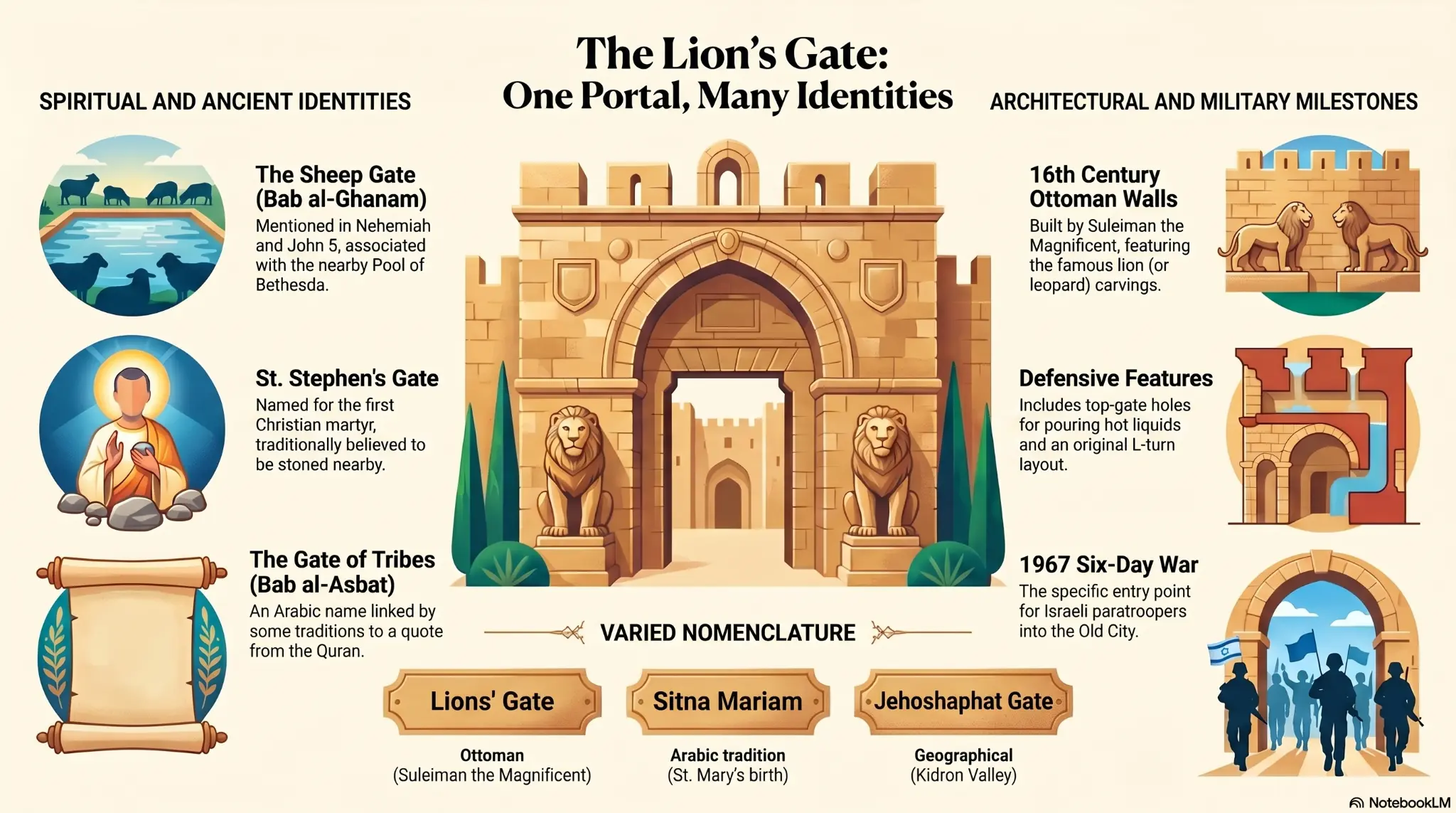
Infographic: NotebookLM
The Sole Eastern Access
Of the eight gates piercing the walls of the Old City, only one provides active access from the east. The Golden Gate (Sha'ar HaRachamim) — the ancient eastern gate directly facing the Mount of Olives — has been sealed since the Mamluk period, with a Muslim cemetery placed in front of it. Lion's Gate, built by Suleiman the Magnificent in the 16th century, therefore stands as the sole functional eastern portal, facing the steep Kidron Valley and the road toward Jericho.
🏛️ 16th Century: Defensive L-Shape
The original Ottoman design featured an L-shaped (bent) entrance — any attacker who breached the outer gate was forced to turn 90° under fire from above. Machicolations (openings in the ceiling) allowed defenders to pour hot liquids on those below. A Suleiman dedication inscription was carved into the wall.
🪖 Modern: Straight-Through Modification
During the Six-Day War (1967), Israeli paratroopers entered the Old City through this exact portal — a moment that became one of the most iconic images of the war. The original L-shape was later modified into a straight-through path to allow modern vehicular access, erasing the defensive architecture.
One Structure, Six Identities
In Jerusalem, a name is rarely just a label. It is a flag planted by a specific tradition. To understand the gate is to unpack each of its six distinct titles — each one revealing a different community's claim on this single portal.
Lion's Gate
Modern / PopularThe universally recognised modern name, popularised after the 16th-century Ottoman construction by Suleiman the Magnificent. The name derives from the carved reliefs flanking the entrance — though those carvings are almost certainly not lions at all (see below).
Know that this is the Ottoman-era name, not a biblical one.
The Imposter Lions of Judah
The carvings flanking the gate are universally called "lions" — but architectural diagnostics suggest they are almost certainly panthers or leopards. The diagnostic mismatch is clear: elongated snout, slender body length, and feline tail structure are all inconsistent with lion anatomy.
The carvings closely match reliefs found on a bridge built by the Mamluk Sultan Baibars — whose name translates directly to "panther." Suleiman the Magnificent almost certainly reused Mamluk-era carvings when constructing the gate in the 16th century.
The popular association with the Lion of Judah — the symbol of Jerusalem — is a modern geographic coincidence, not an intentional iconographic statement by the Ottoman builders.
The Migrating Gate of the Sheep
Nehemiah 3:1 records the rebuilding of the Sheep Gate, and John 5 places Jesus healing a paralysed man near this gate at the Bethesda pool. The connection between the Sheep Gate and Bethesda is therefore a critical biblical link — but the geography is more complicated than it first appears.
The original Sheep Gate was located at the Temple Mount entrance — used by Kohanim (priests) who drove sheep through a secret tunnel for ritual purification before Temple service. When Herod the Great expanded the Temple Mount platform, the physical gate was absorbed into the new construction and lost.
The name migrated eastward to the modern perimeter — the gate we now call Lion's Gate. This is a classic example of how Jerusalem's nomenclature follows memory and function rather than fixed geography.
St. Stephen and the Geography of Memory
According to the Acts of the Apostles, Stephen the Deacon — the first Christian martyr — was stoned outside the city walls. For centuries, Byzantine Christians commemorated this event near the northern wall, in the area of the Damascus Gate. A church was built there to mark the spot.
In the 12th century, memory moved. When Mamluk rulers neglected the northern Damascus Gate area, Christian pilgrims simply relocated the tradition to the more accessible eastern gate. The St. Stephen's Gate name followed the pilgrims, not the archaeology.
"Nothing happened to the history; the pilgrimage simply adapted to politics. Today, two parallel traditions commemorate the exact same event in entirely different locations."
The Path of Sitti Maryam
To local Arabic-speaking Christians, this is Sitti Maryam — Lady Mary's Gate. The name reflects the gate's role as a transitional threshold on a complete Marian pilgrimage route: from the tradition of Mary's birth inside the walls (St. Anne's Church / St. Mary's Church) down through the gate and into the Kidron Valley below, where the Tomb of Mary is located.
Guide note: Know which tradition your group follows — this pilgrimage route is primarily observed by Arabic-speaking Eastern Christians and is less visible to Western tour groups.
Exam Standards vs. Field Reality
📚 The Ministry Exam
- ▸Must use physical texts and heavy Bibles.
- ▸Digital devices are viewed as unprepared or disrespectful.
- ▸Requires rigid adherence to strict historical right/wrong answers.
🌍 The Active Field
- ▸Mobile apps and phones are highly practical; utilised frequently by visiting clergy.
- ▸Accommodation is fluid based on the group.
- ▸Jewish groups prefer the physical Tanakh; Christian groups are entirely comfortable with digital apps.
"The master guide navigates two distinct maps: the rigid historiography required to pass licensing exams, and the fluid, highly empathetic reality of actually guiding diverse pilgrim groups."
Memory Over Hard Geography
The Lion's Gate is more than limestone and machicolations. It is a living blueprint of how Jerusalem functions. Names like "The Sheep's Gate" or "St. Stephen's" prove that in this city, pilgrimage sites are not static coordinates. They are fluid magnets — moving across centuries to accommodate urban expansion, Mamluk politics, and the practical needs of the faithful.
"Geography bends, but the memory endures."