Tabgha
Church of the Multiplication of Loaves and Fishes
On the western shore of the Sea of Galilee, where seven ancient springs feed a lush shoreline, stands one of Christianity's most beloved sites. Here, tradition places the miracle of the feeding of the five thousand — and beneath your feet, a 6th-century Byzantine mosaic floor laid by Egyptian craftsmen tells a story that spans 2,000 years.
The Sacred Site & Its Miracle
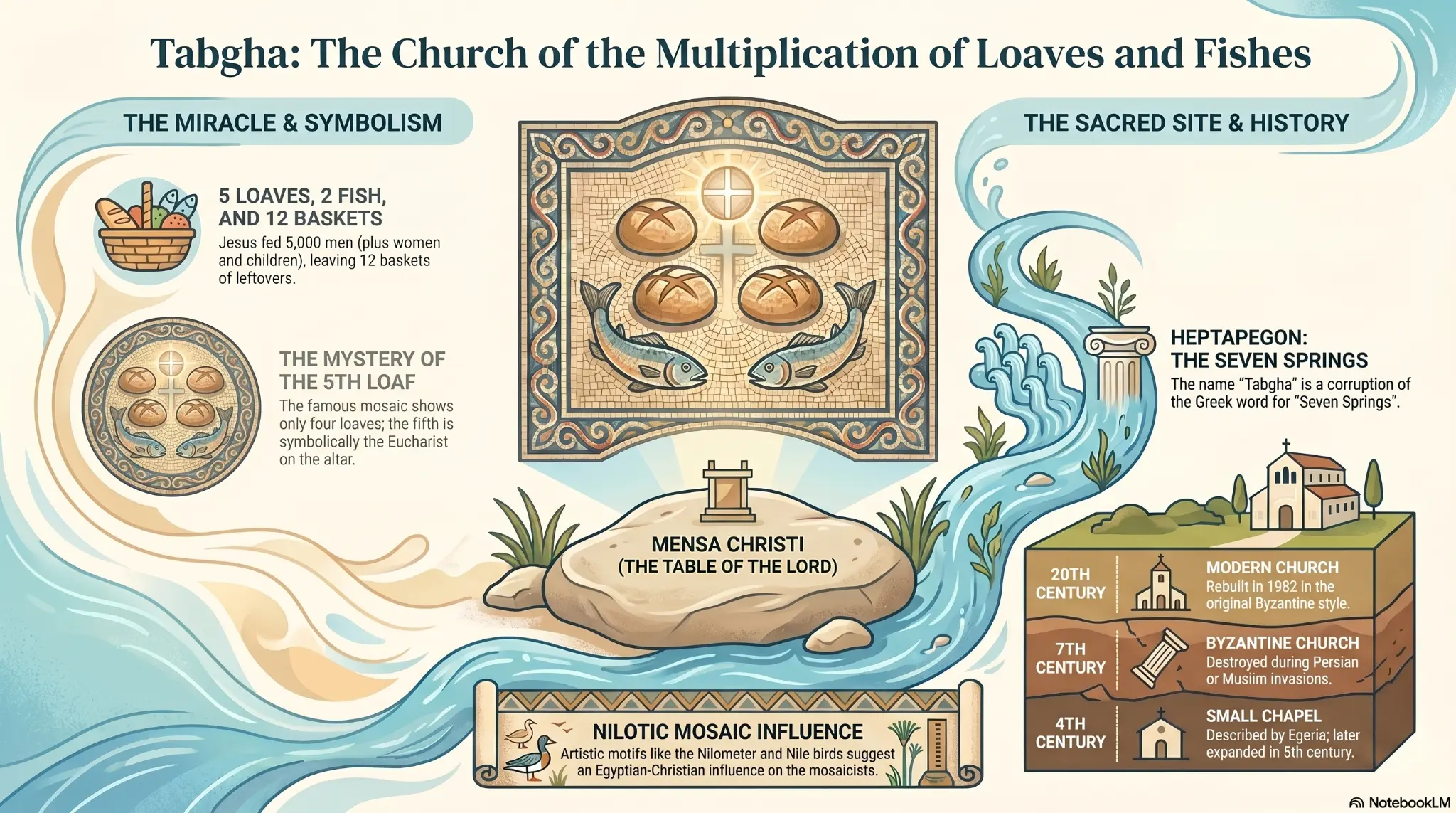
A visual overview of Tabgha's miracle, symbolism, and architectural history
Watch: Tabgha — The Church of the Multiplication
A guided video tour of the site, the mosaics, and the miracle
Five Loaves, Two Fish, and Twelve Baskets
According to the Gospel of Matthew (14:13–21), Jesus took five loaves of bread and two fish, gave thanks — likely reciting the Jewish Hamotzi blessing — broke the bread, and passed it to his disciples to distribute to a crowd of five thousand men, besides women and children. When the meal was over, twelve baskets of leftovers remained.
The detail that Jesus gave the food to the disciples to distribute — rather than approaching the crowd directly — carries significant theological weight. For the Catholic tradition, it established the foundational principle of the clergy as intermediaries between the divine and the faithful, a role re-enacted in every celebration of the Eucharist.
The twelve baskets of leftovers are widely understood as a reference to the twelve tribes of Israel — the abundance of the miracle overflowing to encompass the whole of the Jewish people.
Egeria's Account (380–382 AD)
"In the same place by the sea of Tiberias is a grassy field with plenty of hay and many palm trees. By them are seven springs, each flowing strongly... the stone on which the Lord placed the bread has now been made into an altar. Past the walls of this church goes the public highway where the apostle Matthew had his place of customs."
— Egeria, Itinerarium Egeriae, c. 381 AD
Four Layers of Continuous Pilgrimage
"To stand in Tabgha today is to step on 6th-century floors, to look at a 1st-century rock, inside a 20th-century church, participating in a 2,000-year-old story."
The Grassy Field
c. 30 AD
An open shoreline where Jesus performed the miracle of the loaves and fishes. The Mensa Christi — a pale limestone rock — served as the natural table. No structure existed; only the landscape, the crowd, and the miracle.
- ▸5,000 men (plus women and children) fed
- ▸5 loaves + 2 fish → 12 baskets of leftovers
- ▸Jesus gave food to disciples to distribute — the theological basis for clerical intermediaries
- ▸The Mensa Christi rock is the only physical survivor from this era
Three Zones of the Church
The Atrium
The Secular Courtyard
Ancient Olive Press
A basalt millstone and beam press — guides connect this to Gethsemane ("oil press"), linking Galilee to Jerusalem.
The Baptistry
A 5th-century limestone baptistry from near Hebron, cross-shaped and sized for adult immersion — reflecting early Christian conversion practices.
Roman Milestone
Marks the Via Maris — the ancient road from Tiberias to Damascus where Matthew the Apostle collected taxes.
Seven Fish Taps
A modern water feature with seven fish-shaped taps representing the seven springs (Heptapegon) that give Tabgha its name.
The Narthex
The Transitional Entry
Spiritual Threshold
Originally reserved for catechumens — those preparing for baptism. Crossing into the sanctuary was a deliberate act of faith.
Byzantine Orientation
The church faces east — toward the sunrise — following the tradition adopted from gentile prayer practices. 90% of Byzantine churches share this orientation.
Orthodox Iconography
Icons of Christ Pantocrator and the Theotokos (Mary with Child) honor the pre-schism Byzantine roots within a modern Catholic space.
The Sanctuary
The Altar & Mosaics
The Mensa Christi
A pale limestone rock, now jet-black from centuries of candle soot. The modern altar is raised above it on metal legs, preserving the original surface.
The Famous Mosaic
The 5th/6th-century mosaic shows 4 loaves and 2 fish. The 5th loaf is the Eucharist on the altar — every Mass re-enacts the miracle.
The Nilotic Border
Herons, ducks, lotus flowers, and a Nilometer — distinctly Egyptian imagery suggesting imported craftsmen from the Nile Delta.
Nearby Dalmanuta
A short walk toward the shore: an open-air altar on the beach with rock-made seats, bookable for private masses and contemplation.
Decoding the Byzantine Floor
The 5th–6th century mosaic is one of the most studied floors in the Christian world. Each element carries layers of meaning — theological, geographical, and artistic.
The Dora Fish
The fish in the mosaic is biologically a "Dora" — a species native exclusively to the Nile River, not the Sea of Galilee. This is the strongest evidence that the 6th-century floor was laid by imported Egyptian craftsmen.
Egyptian Echoes: The Imported Artisans
The Byzantine mosaic floor contains two biological and architectural anomalies that have puzzled scholars for decades. Together, they point to a single conclusion: the 6th-century floor was not laid by local Galilean craftsmen, but by artists imported from Egypt.
The Dora fish depicted in the central mosaic is biologically a species native exclusively to the Nile River — it does not exist in the Sea of Galilee. An artist painting from local observation would have depicted a tilapia or sardine. Only someone familiar with the Nile would have painted a Dora.
The Nilometer — an ancient Egyptian flood-measurement tower — appears in the border mosaic as a Christian symbol of blessing and fertility. This same motif appears in the Zippori mosaics (also attributed to Egyptian craftsmen), suggesting a shared artistic workshop tradition connecting Galilee to the Nile Delta in the 6th century.
The Dora Fish
Biologically identified as a Dora — a species native exclusively to the Nile River. Its presence in a mosaic depicting a Sea of Galilee miracle is the strongest single piece of evidence for Egyptian artisan involvement.
The Nilometer
A tower with Greek letters (Alpha through Omega) used to measure Nile flood levels. Depicted here as a Christian symbol of fertility and the Garden of Eden — the same motif appears in the Zippori Dionysus mosaic, linking both sites to a common Egyptian workshop tradition.
The Nilotic Border
The border mosaic depicts herons, ducks, lotus flowers, and waterfowl in a distinctly Egyptian Nilotic style — a common motif in wealthy Egyptian Christian homes and churches, used to symbolize paradise and abundance.
Visitor Information
Fast Facts for the Field
"Tabgha" derives from Greek "Heptapegon" (Seven Springs) via Arabic corruption
The miracle: 5 loaves + 2 fish fed 5,000 men, leaving 12 baskets of leftovers
Jesus gave food to disciples to distribute — theological basis for clerical intermediaries
Egeria (380–382 AD) is the earliest written source describing the site
The Mensa Christi appears jet-black today due to centuries of candle soot
The famous mosaic shows only 4 loaves — the 5th is the Eucharist on the altar
The fish in the mosaic is a Dora (Nile species), not a Sea of Galilee tilapia
The Nilometer mosaic links the artists to Egyptian craftsmen and the Zippori school