Bet Guvrin-Maresha
The Subterranean Super-City of the Shephelah
The Dossier · 14 Field Reports
Field Report No. 01 of 14
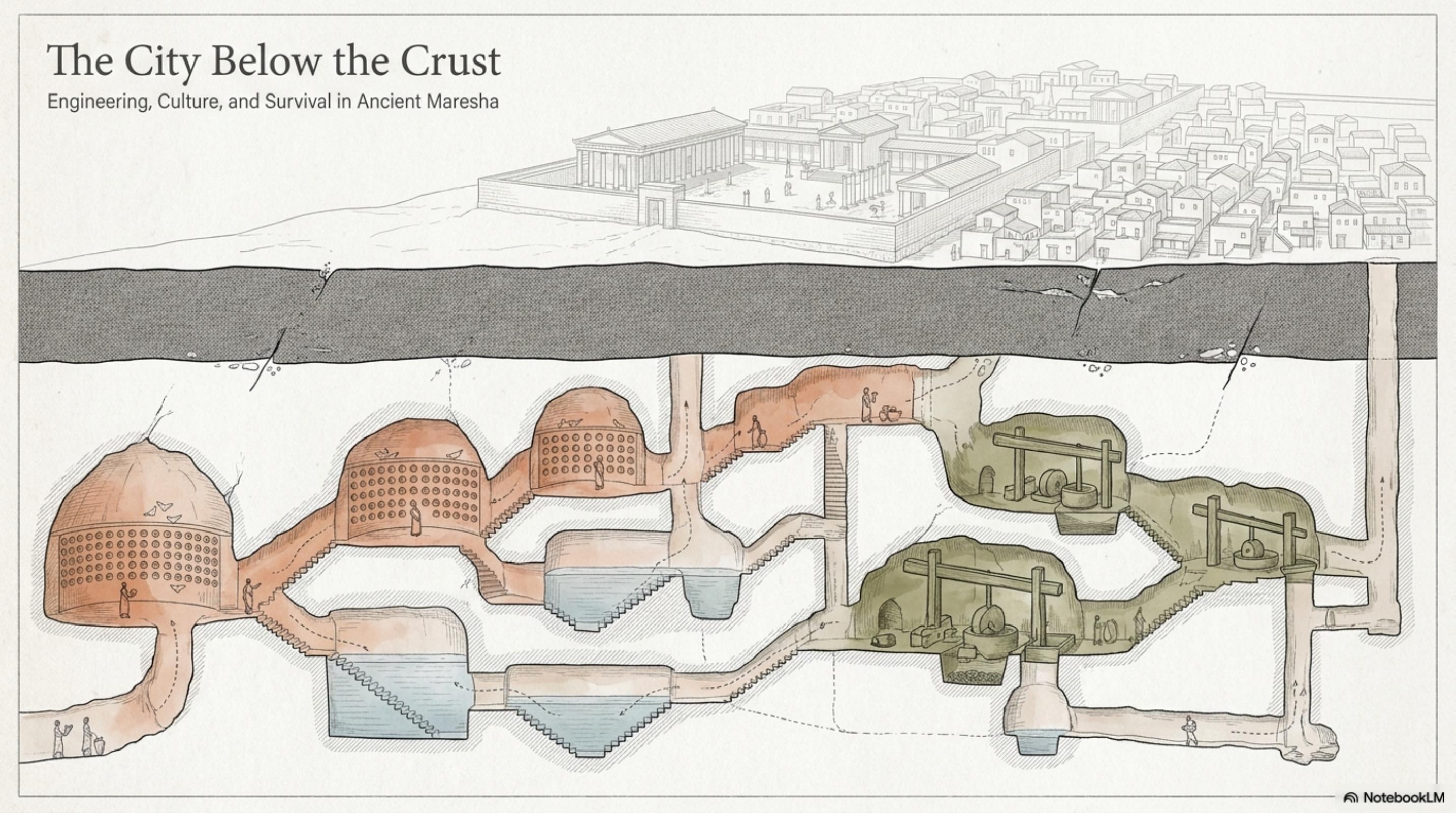
The City Below the Crust: Engineering, Culture, and Survival in Ancient Maresha
Field Video
Bet Guvrin-Maresha — When the Dirt Proves the Text
Visitor Guide
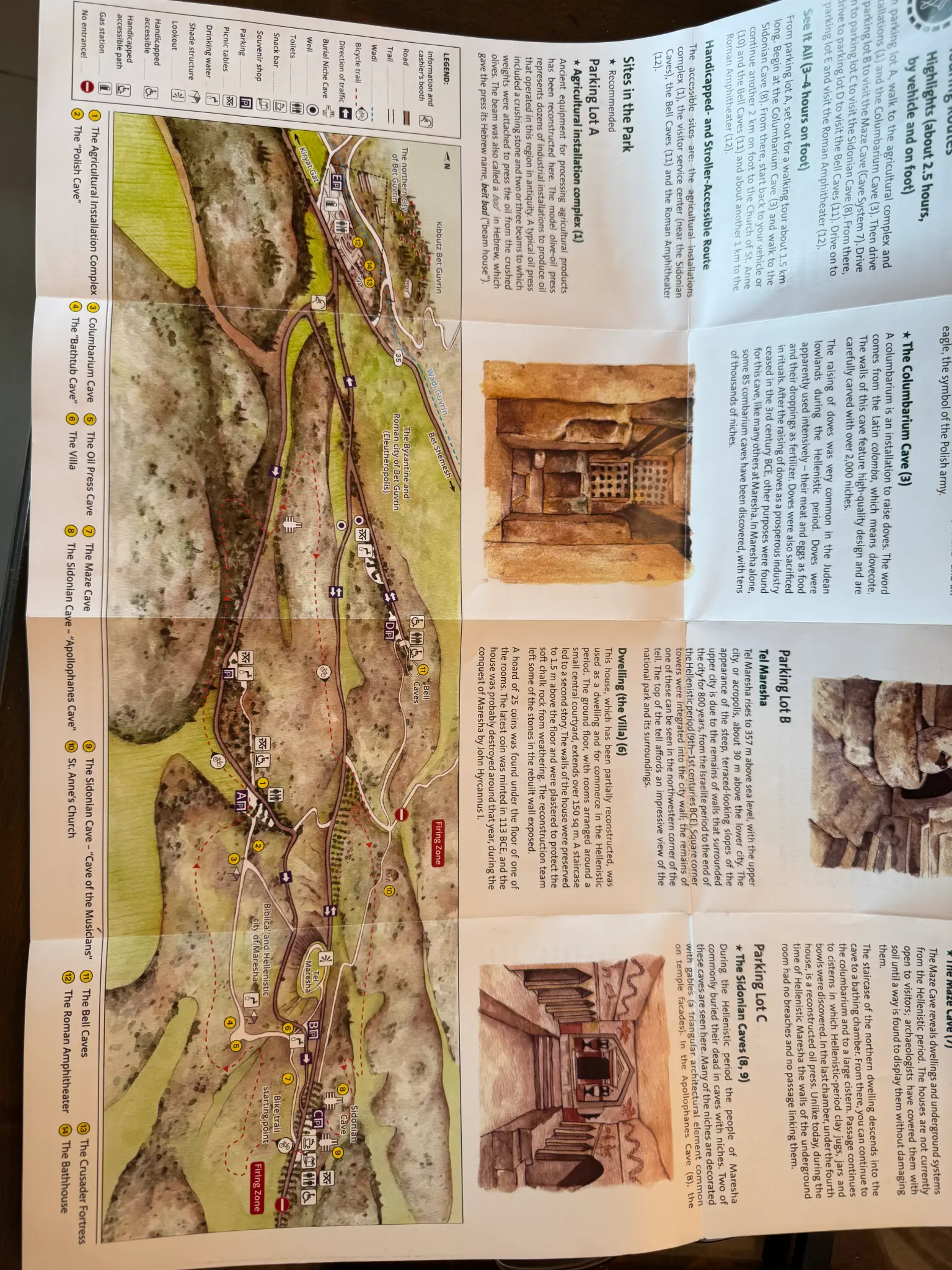
Official site map — click to enlarge
Points of Interest
Agricultural Installation Complex
Reconstructed agricultural installations including an olive-oil press. The model shows how oil was extracted from the crushed olives. The press operated in this region in antiquity.
The Polish Cave
Hewn in the Hellenistic period. The walls of this cave feature high-quality design and are apparently carved with over 2,000 niches — the symbol of the Polish army.
The Columbarium Cave
A columbarium is an installation to raise doves. The walls feature high-quality niches for doves. Raising doves was very common in the Judean lowlands during the Hellenistic period for fertilizer, food, and sacrifice.
The Bathtub Cave
A small cave that was used during the Hellenistic period as a bath. The cave consists of a small chamber with two small chambers; one of the lower chambers has a stepped stone tub.
The Oil Press Cave
One of 42 underground oil presses discovered at Maresha. Most are from the Hellenistic period. Pure oil took seven days to drip — explaining the eight-day Hanukkah miracle significance.
The Villa (Dwelling)
A dwelling partially reconstructed from the Hellenistic period. The ground floor had rooms arranged around a small central courtyard. The walls were plastered to protect the soft chalk rock from weathering.
The Maze Cave
The structure of the northern dwelling descends into the soil until a way is found to display them without damaging the caves. The Maze Cave reveals dwellings and underground systems from the Hellenistic period.
The Sidonian Caves
The people of Maresha commonly buried their dead in caves with niches. Two of these caves are triangular architectural elements — the Apollophanes Cave — decorated with temple facades.
Cave of the Musicians
In the southern cave, paintings have been reconstructed depicting musicians. The Apollophanes inscription identifies Tel Maresha with biblical Maresha and reveals Sidonian family relationships and burial customs.
St. Anne's Church
Located on the path between parking lots C and D. A very large church (52 x 56 m) was built during the Byzantine period. The church was restored on a smaller scale during the Crusader period.
The Bell Caves
The Bell Caves are within the city limits of Bet Guvrin itself. The caves were used mainly as quarries during the Byzantine and Early Muslim periods. The 10th-century Arab traveler Al Muqaddasi wrote of Bet Guvrin: 'It is a land of richness and plenty.'
The Roman Amphitheater
One of only two Roman amphitheaters in Israel. Semi-circular with 3,500 seats; used mainly for gladiator fights between differing purposes. Bet Guvrin has the only round arena open to the public in Israel.
The Crusader Fortress
Located east of and adjacent to the amphitheater. Remains of a basilical church were found in the 1136 by King Fulk d'Anjou of Jerusalem, built in the Romanesque style. The church was adorned with Roman and Byzantine stone bases, columns and capitals.
The Bathhouse
The remains of a large Roman-era bathhouse covering over 4,000 sq m. Like every Roman bathhouse, it included tepid, hot and cold rooms, saunas, open areas and toilets. The vaults were built of finely dressed ashlar stones.
Historical Background
Bet Guvrin-Maresha National Park covers two adjacent ancient cities: Maresha (Tel Maresha), a hilltop Hellenistic city, and Bet Guvrin, a Roman-period highway settlement on the flat plain below. Together they span over 3,000 years of continuous human occupation, from the Israelite period through the Crusader era.
Maresha was fortified by King Rehoboam of Judah following the campaign of the Egyptian Pharaoh Shishak, and Rehoboam built cities for defense in the region of Judah — Gath, Maresha, and Ziph (2 Chron. 11:5–8). Shortly thereafter, in the early 9th century BCE, Joshia's son Asa defeated an army to Judah under the command of his general Zerah the Ethiopian. However, King Asa of Judah defeated him near Maresha.
During the Persian period, after the destruction of the First Temple, Idumeans (Edomians) who came from the region became known as Idumeans in southern Judah and the region became known as Idumea. Maresha was also home to a few Egyptians and Jews. Maresha was a cosmopolitan center and an economic magnet and was also home to a few Egyptians and Jews. Some of the Jews were descendants of the local population and others came from coastal plain cities.
The Hellenistic period saw the construction of Lower Maresha. Many caves were also hewn during this time. Historical sources and excavations reveal that in 113/12 BCE the Hasmonean king John Hyrcanus conquered Idumea and forcibly converted its inhabitants. Hyrcanus also laid waste to the city.
The Crusader fortress is located east of and adjacent to the amphitheater. Remains of a basilical church, built in the Romanesque style, which was built in the Romanesque style, were found in the 1136 by King Fulk d'Anjou of Jerusalem. The church was adorned with Roman and Byzantine stone bases, columns and capitals that had been taken from the remains of ancient Bet Guvrin.
Maresha was eventually reinhabited, but its glory days were past and it remained a small settlement. It was completely destroyed in 40 BCE in a military campaign by the Parthians, and who controlled Western Asia beyond the Euphrates River and were the enemies of Rome.
UNESCO World Heritage Site: The Caves of Maresha and Bet Guvrin were inscribed as a UNESCO World Heritage Site in 2014 at UNESCO's 38th annual meeting in Doha. The site is recognized as an outstanding example of subterranean settlement, representing a unique form of human interaction with the landscape.
The Guide's Narrative
The first thing you notice at Bet Guvrin-Maresha is the silence. You descend a narrow staircase cut into the chalk, and the noise of the world above — the wind, the birds, the distant traffic — disappears completely. You are inside the earth, and the earth is enormous. The cave opens around you into a perfect bell shape, thirty meters across, the walls honeycombed with hundreds of small niches. You are standing inside a columbarium — a dove house — and it is one of the most extraordinary spaces in the entire country.
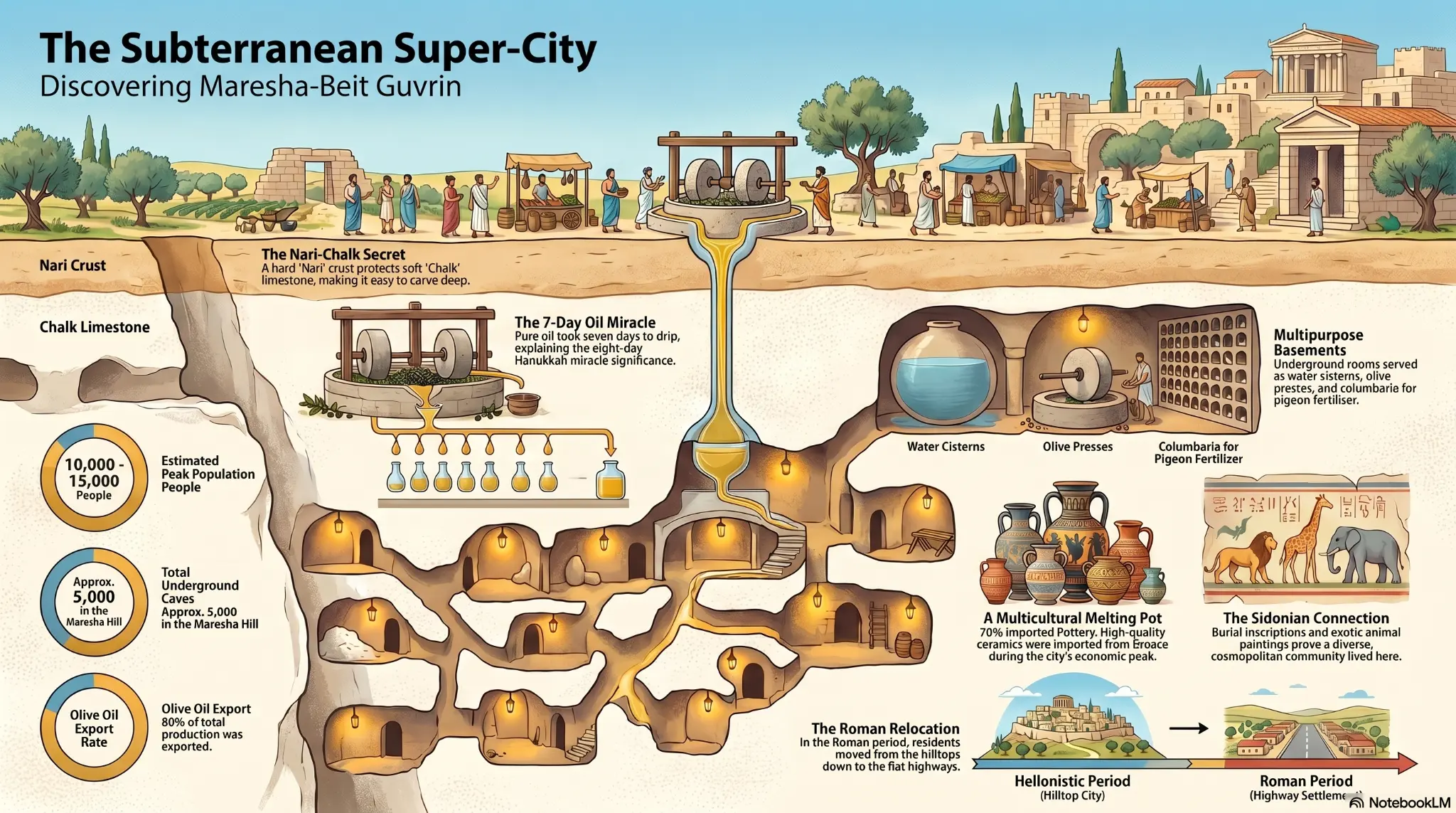
This is the genius of Maresha. The city that existed here from the 4th to the 2nd century BCE was a Hellenistic boom town, a cosmopolitan trading hub that exported olive oil across the Mediterranean world. But its real infrastructure was invisible. The hard Nari crust that covers the Shephelah hills protects a deep bed of soft chalk limestone underneath — and the people of Maresha discovered that you could carve that chalk into anything. Cisterns, oil presses, storage rooms, columbaria, burial caves, workshops. The entire economic engine of the city ran underground, out of sight, perfectly temperature-controlled, protected from the summer heat and the winter rain.
The numbers are staggering. Approximately 5,000 caves have been identified in the Maresha hill alone. Forty-two underground olive oil presses have been found — each one capable of producing hundreds of liters per pressing cycle, with 80% of the output destined for export. The columbaria housed thousands of doves, whose droppings were collected as fertilizer for the olive groves above. The cascading cistern systems captured every drop of the region's 350mm annual rainfall and channeled it through a network of underground channels to storage pools that could sustain the city through the dry season.
What makes Maresha truly remarkable is its multiculturalism. The city was founded by Sidonians — Phoenicians from the Lebanese coast — who had settled in the Shephelah after the Babylonian conquest. But by the Hellenistic period it had become a genuine melting pot: Edomians, Greeks, Egyptians, and Jews all lived here together. Seventy percent of the pottery was imported from Greece. The burial caves contain inscriptions in Greek, Aramaic, and Phoenician. The Cave of the Musicians, in the southern part of the site, contains paintings of musicians, mythological animals, and hunting scenes — including a giraffe painted from hearsay by someone who had clearly never seen one.
The story ends abruptly in 108 BCE, when the Hasmonean king John Hyrcanus conquered the city and forcibly converted its Edomian population to Judaism. A treasure jar containing silver coins minted in 112 BCE was found hidden under the floor of one of the houses — the last act of someone who expected to return and never did. The city was finally destroyed by the Parthians in 40 BCE and never rebuilt. The Romans relocated the settlement to the flat highway junction below, renaming it Bet Guvrin. The hill was abandoned, and the underground city was sealed for two thousand years.
Exam Fast Facts
UNESCO Status
World Heritage Site since 2014 (Caves of Maresha and Bet Guvrin)
Peak Population
10,000–15,000 people at Maresha's height
Underground Caves
~5,000 caves in the Maresha hill alone
Geology
Hard Nari crust (2m) over soft chalk limestone — enabled deep carving
Olive Oil Export
80% of production exported; 42 underground oil presses discovered
The Columbarium
Over 2,000 niches for doves; used for fertilizer, food, and sacrifice
Hasmonean Conquest
108 BCE — John Hyrcanus conquered and forcibly converted the Edomian population
The Sidonian Connection
Apollophanes son of Sesmaios inscription; exotic animal paintings reveal cosmopolitan community
Roman Period
City relocated from hilltop (Maresha) to flat highway junction (Bet Guvrin)
The Roman Amphitheater
One of only two Roman amphitheaters in Israel; 3,500 seats; used for gladiatorial combat
Published April 27, 2025
_040eb681.webp)