Capernaum
Layers of Faith and History
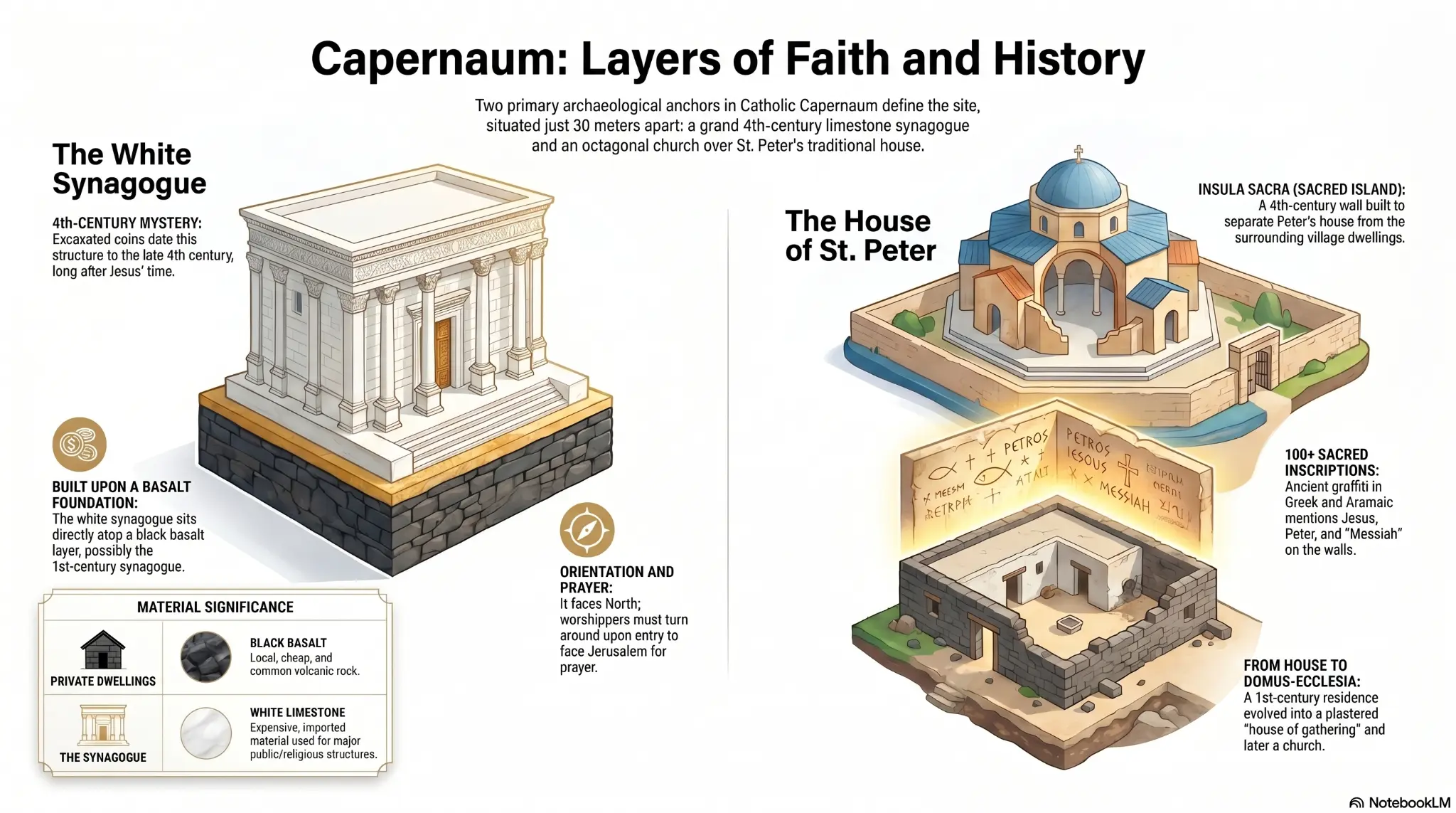
Two primary archaeological anchors — a grand 4th-century limestone synagogue and an octagonal church over St. Peter's house — stand exactly 30 meters apart in this humble fishing village on the Sea of Galilee. The proximity is the paradox.
Visual Field Guide
The Two Monuments of Capernaum
Field Video
Watch: Capernaum
Section 1
Introduction to Capernaum
A Humble Town on the Border
Capernaum was the chosen hometown of Jesus and a major hub for fishermen and fish trading on the Sea of Galilee. Built entirely of local black basalt, the village sat directly on the Via Maris — the ancient main road connecting Egypt to Mesopotamia — at the precise border between the provinces ruled by King Herod's sons, Philippos and Antipas.
Because it was a border town, it required a customs house and a tax collector. That post was held by the disciple Matthew (Levi), who is historically recorded at exactly this location.
Untouched by the Great Revolt
Capernaum survived the Great Revolt against the Romans in 70 AD completely untouched. It was small, unfortified, and considered militarily insignificant — the Romans simply had no reason to destroy it. As a result, its 1st-century structures survived intact, giving archaeologists a rare, uninterrupted window into village life at the time of Jesus.
Today the ancient site is physically divided: the Catholic (Franciscan) western side contains the primary 1st-century ruins, the White Synagogue, and St. Peter's House; the Greek Orthodox eastern side contains a later Arab-period settlement built after the site was abandoned following the 749 CE earthquake.
The Material Paradox of Capernaum
Local, cheap, and common volcanic rock. Used for all private dwellings in the village — the material of everyday life.
Expensive, imported material used only for major public and religious structures. The White Synagogue towers above the basalt ruins in stark contrast.
Section 2
The White Synagogue
A grand 4th-century basilica of imported white limestone — towering above the black basalt ruins of the village it was built upon.
Built on Black Stone
The White Synagogue is a massive, basilica-shaped structure made of imported white limestone, which stands in stark contrast to the older, lower-level black basalt foundations of the town surrounding it. Foundation coins found beneath the floor firmly date the white structure to the late 4th century — centuries after the time of Jesus.
The 4th-century synagogue sits precisely on top of older, black basalt foundations. While unproven, this underlying footprint is widely believed to be the original 1st-century synagogue where Jesus preached.
The "Wrong Direction" Entrance
Worshippers enter the synagogue facing North — away from Jerusalem. To pray, they must physically stop and turn 180° to face South, toward Jerusalem and the Holy Ark.
The Cognitive Shift
Archaeologists theorize this physical turn forced a mental turn. It acted as an architectural airlock, forcing the congregant to consciously leave behind the daily chores, laundry, and labor of the bustling village outside before entering a state of prayer.
The Visual Glossary: Stone Carvings
The Menorah
Unambiguously and 100% Jewish, firmly identifying the religious origins of the carvers. The seven-branched lampstand is the oldest and most universal Jewish symbol.
Star of David & Star of Solomon
Features both the six-pointed Star of David and the five-pointed 'Star of Solomon.' While common here, these were used as general decorative motifs across both Jewish and non-Jewish cultures at the time.
The Holy Ark on Wheels
A rare depiction of a mobile ark, suggesting the Torah was transported in and out of the synagogue solely for prayer times — not permanently housed there.
Vessel with Grapes
A crossover motif. Originating as a standard Roman decorative symbol, it was rapidly adopted into early Christian iconography — evidence of the cultural overlap at Capernaum.
The Zebedee Inscription
The Stones Speak
The Artifact
Among the ruins of the synagogue is a carved column featuring a deeply worn inscription: Yohanan (John) and Zabdai (Zebedee).
The Significance
Zebedee was the father of James and John, two of Jesus's first disciples. While it may refer to a later local donor from a family of the same name, the inscription permanently links prominent names of early Christianity into the very bedrock of the Jewish synagogue.
Section 3
The House of St. Peter & The Insula Sacra
Five layers of history stacked on a single basalt room — from a fisherman's house to a suspended glass-floor church.
The Stratigraphy of a Sacred Site
Layer 1 · 1st Century AD
The Basalt Dwelling
A simple, unplastered black basalt room in a maze of cramped domestic housing — sweltering in the Galilee heat. One of these humble rooms belonged to Simon (Peter), a local fisherman. Indistinguishable from any other house in the village.
- Built from local black basalt — cheap, abundant volcanic rock
- Part of a dense insula (block) of interconnected family dwellings
- No ornamentation, no plaster — a working fisherman's home
- Jesus is said to have healed Peter's mother-in-law here (Mark 1:29–31)
The Promise of Eternity
The Peacock Mosaic
The Artifact
Displayed at the site is a replica mosaic from the floor of the 5th-century Octagonal Church.
The Symbolism
The mosaic prominently features a peacock. In Byzantine Christian tradition, it was widely believed that the flesh of a peacock did not rot after death.
The Meaning
The bird became a powerful architectural symbol for eternal life — a fitting motif for a humble 1st-century fishing village whose basalt and limestone foundations have stubbornly refused to fade into history.
Section 4
The 30-Meter Paradox
Nowhere else in the ancient world is there a monumental 4th-century Jewish synagogue and a major 5th-century Christian church existing concurrently in such extreme proximity. Two theories attempt to explain it.
Synagogue
4th Century
Exactly
Church
5th Century
By the late 4th century, Christianity was rapidly becoming the dominant, official religion of the empire, and Jewish-Christian relations were historically fraught. Yet in Capernaum, two massive, well-funded, competing religious communities seemingly worshipped a stone's throw apart.
Unprecedented Tolerance
Capernaum housed a uniquely harmonious population of wealthy Orthodox Jews and 'Christian Jews' (referred to in the Talmud as Minim). They shared the geographical space with deep, localized tolerance, pouring wealth into their respective monuments.
Pilgrim Tourism
Reena Talgam's Theory
The Jewish community could not have supported such a massive structure during an era of Christian dominance. Instead, the 'synagogue' was essentially built as an ancient tourist attraction — funded and maintained by wealthy Christian pilgrims who traveled from afar specifically wanting to see 'the synagogue of Jesus.'
Field Dossier
The Capernaum Paradox
Full slide dossier — all 14 slides from the field playbook.
Study Guide
Fast Facts for the Field
Capernaum was the chosen hometown of Jesus and a major hub for fishermen and fish trading on the Sea of Galilee
The town sat on the Via Maris — the ancient main road — directly on the border of the provinces ruled by Herod's sons Philippos and Antipas
Being a border town required a customs house and tax collector; the disciple Matthew (Levi) held this post
Capernaum survived the Great Revolt of 70 AD completely untouched — it was small, unfortified, and considered militarily insignificant
Today the ancient site is physically divided: the western (Catholic/Franciscan) side contains the primary 1st-century ruins; the eastern (Greek Orthodox) side contains a later Arab-period settlement
The White Synagogue is a massive 4th- or 5th-century basilica of imported white limestone, sitting directly on top of older black basalt foundations believed to be the 1st-century synagogue where Jesus preached
Foundation coins found beneath the synagogue floor firmly date the white structure to the late 4th century — centuries after Jesus
The synagogue faces North — worshippers enter facing away from Jerusalem and must physically turn 180° to face South for prayer, acting as an 'architectural airlock'