The KotelThe Western Wall
How a Herodian retaining wall — built to support a platform, not enclose a sanctuary — became Judaism's holiest accessible place of prayer through centuries of memory, law, imperial policy, and national longing.
The Central Distinction
The Kotel is not the holiest site in Judaism — the Temple Mount and the Holy of Holies hold that status. It is the holiest generally accessible place of Jewish prayer, because it stands as the closest accessible threshold to the forbidden sacred center.[1],[2]
Its extraordinary status developed gradually. The present Wall's role as a defined prayer site crystallized mainly in the sixteenth and seventeenth centuries under Ottoman rule — not in 70 CE when the Temple was destroyed.[1],[5]
The Sacred Threshold: How the Wall Became Holy
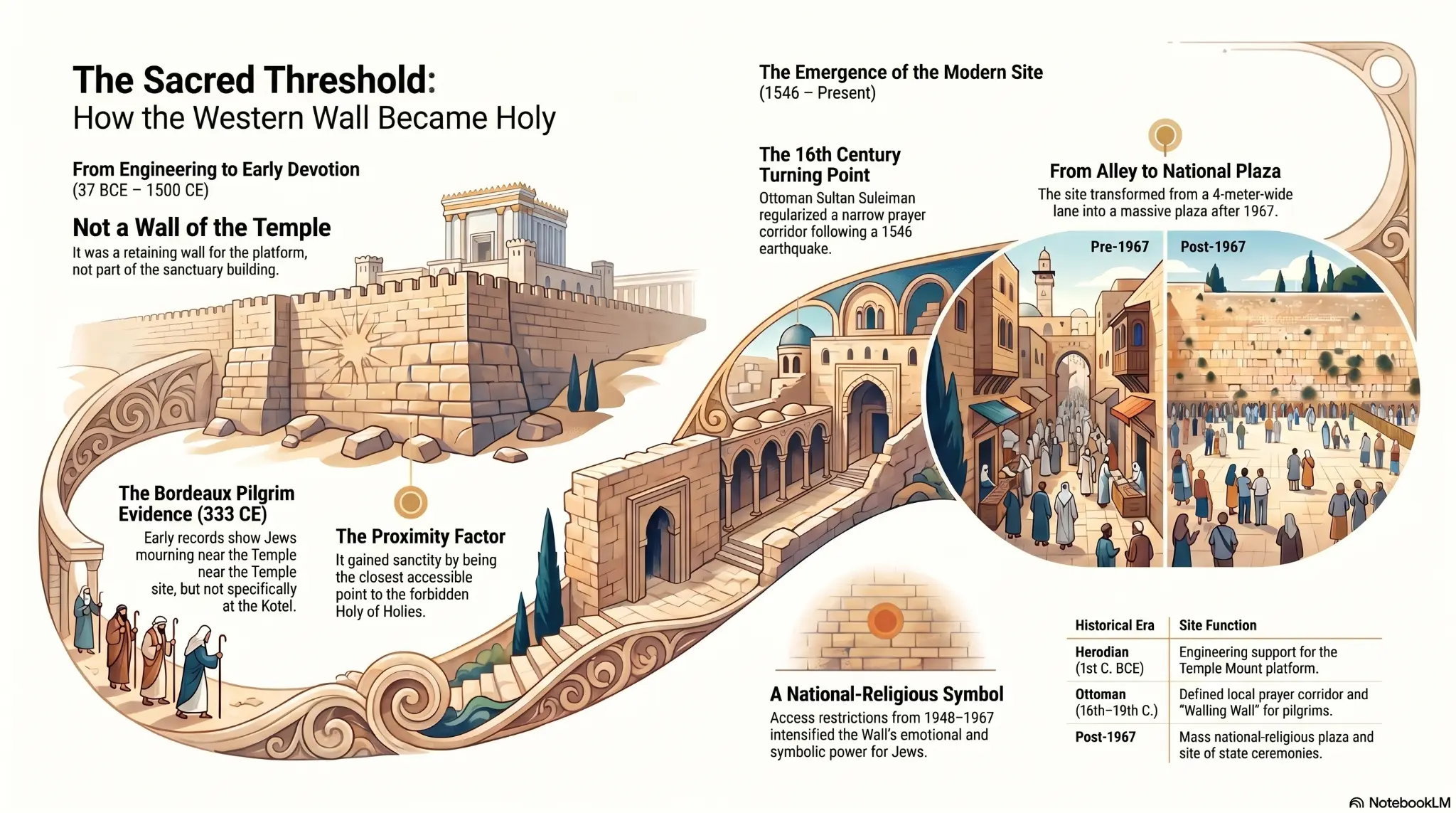
Infographic: The Sacred Threshold — From Engineering to Early Devotion (37 BCE–1500 CE) and The Emergence of the Modern Site (1546–Present)
Myth vs. Historical Consensus
Four widely held assumptions examined against the scholarly record.
The Halakhic Barrier: Why Devotion Moved to the Perimeter
The Kotel's rise was not merely circumstantial — it was legally mandated by Jewish law itself.
The Rule of Enduring Sanctity
Maimonides codified that the Temple Mount's sanctity endures even in ruins, commanding enduring reverence. The site remained holy — and therefore dangerous to enter carelessly.[8]
The 5 Layers of Sanctity
The Kotel did not start as a holy wall. It became holy through five distinct historical accumulations.
"The Kotel did not start as a holy wall. It became holy because generations of Jewish prayer, halakhic boundaries, imperial dictates, and deep historical longing sanctified it through use. It is the ultimate threshold between the exiled and the sacred."
— Sanctifying the Stone, Synthesis slide
Historical Timeline
Herod Begins Expansion
Herod the Great embarks on the most ambitious building project in the ancient Near East — doubling the size of the Temple Mount platform. The western retaining wall is laid as pure engineering support.[1]
The Bordeaux Pilgrim
The earliest clear account of Jewish mourning at the Temple site. The Christian pilgrim describes Jews anointing a stone and tearing their garments — but does not identify today's Kotel prayer section specifically.[9]
Benjamin of Tudela
The Spanish Jewish traveler describes Jews praying before a 'western wall,' but ambiguously associates it with the Gate of Mercy on the eastern wall — revealing that geography was still fluid.[10]
Political Flashpoint
Violent clashes over benches and shofar-blowing lead to the 1930 International Commission, which grants Jews free devotional access while recognizing Muslim ownership of the wall and pavement.[11]
19 Years of Absence
Under Jordanian control, Israeli Jews are entirely barred from the Wall. The forced separation intensifies the Wall's emotional and national significance — setting the psychological stage for 1967.[5]
1967: The Spatial Transformation
The Crucible of Absence (1948–1967)
For 19 years under Jordanian control, Israeli Jews were entirely barred from the Wall despite armistice commitments regarding access to holy places.[5] This forced separation intensified the Wall's emotional, religious, and national significance — setting the psychological stage for the dramatic events of June 1967.
Exam Fast Facts
12 key pointsThe Kotel is not the holiest site in Judaism — the Temple Mount / Holy of Holies is. It is the holiest generally accessible place of Jewish prayer.
The wall's stones were laid by Herod (37–4 BCE) as structural support for the Temple Mount platform, not to enclose the sanctuary.
The earliest unambiguous evidence for Jewish prayer at today's specific section dates to the 16th–17th centuries, not 70 CE.
The 1546 earthquake was the catalyst: Ottoman authorities cleared rubble and regularized the prayer corridor under Sultan Suleiman.
The pre-1967 prayer space was a 4-meter-wide alley hemmed in by the Mughrabi (Moroccan) Quarter.
The Mughrabi Quarter was demolished within days of the Israeli capture of the Old City in June 1967.